Desktop 3D printers release fine particles even with PLA filament – HSE research shows which simple measures cut exposure at home.
Key points
- A Health and Safety Executive (HSE) laboratory study found that heated PLA and ABS filament released large numbers of very small particles and volatile chemicals.
- According to HSE, a lower nozzle temperature, a lower-emission filament and an enclosing hood with extraction and a particle filter significantly reduce exposure.
- HSE researchers name a hood clearance time of about 20 minutes as one of these measures.
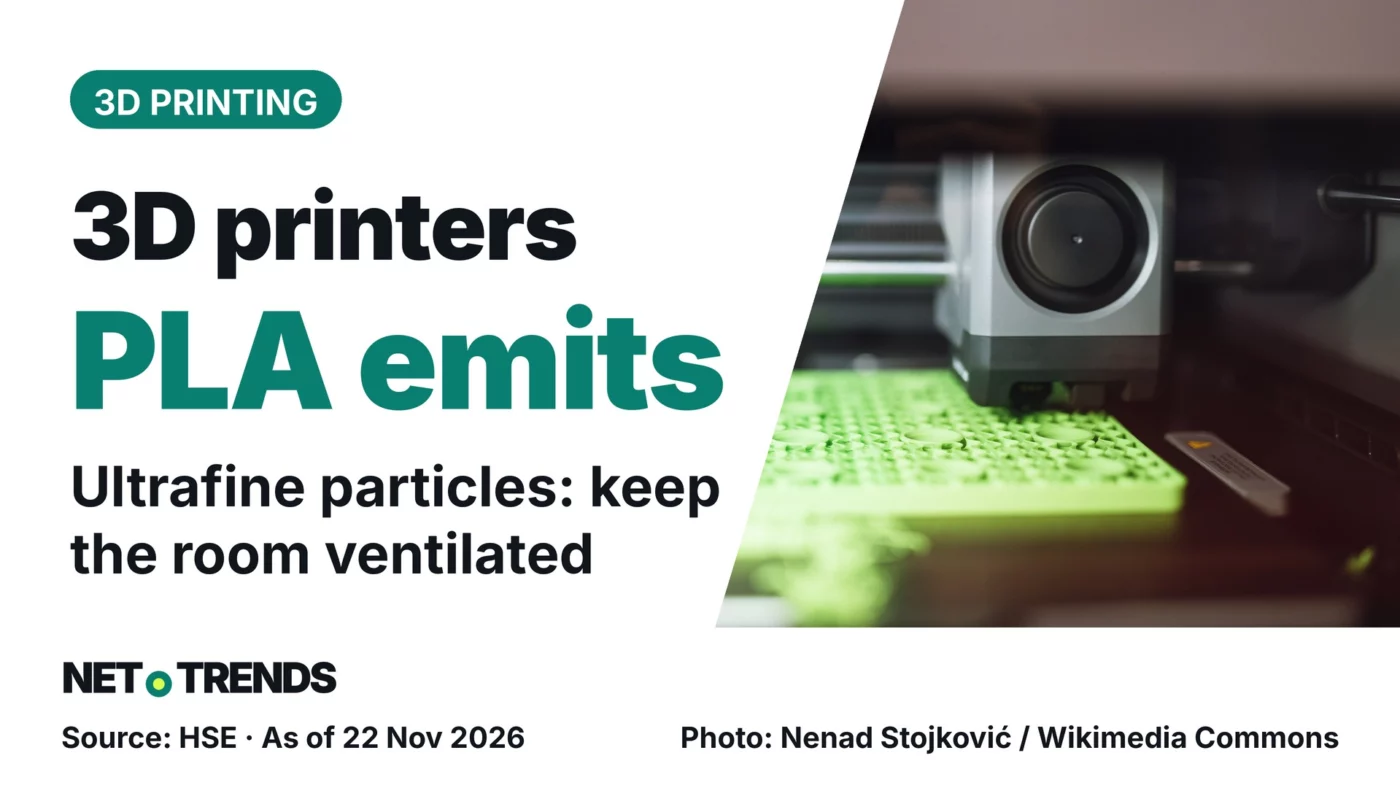
3D printers can release ultrafine particles even when they print with PLA. Anyone running one at home should decide where it stands and how the room is ventilated before the first print.
PLA, short for polylactic acid, is often sold as the easy, low-odour filament for beginners. That reputation is partly deserved: it usually emits less than ABS. But lower emissions are not the same as none, and the research from Britain’s workplace safety regulator makes that clear.
The findings are not a new warning about one particular printer. They describe how the fused-filament process works in general, which is why they matter for any model you already own or are thinking of buying.
HSE study: PLA and ABS both emit
In its research report RR1146 on emissions from polymer filament desktop 3D printers, HSE tested PLA and ABS in the laboratory. The heated filaments released large numbers of very small particles that can be breathed in, along with volatile organic compounds.
HSE points out that most affordable desktop printers are unenclosed and are used in offices, schools and colleges. The same report says that more research is needed to establish whether real-world emissions reach harmful levels. Its findings fed into a good practice guide for schools published by CLEAPSS in 2019.
PLA emits less than ABS – not nothing
The German research institute Fraunhofer WKI summarises the emissions from 3D printers (in German): ultrafine particles, volatile organic compounds and less volatile additives from the filament. ABS usually shows higher emission rates than PLA. Higher print temperatures generally lead to higher emissions as well.
In practice, the label on the spool is only part of the answer. The manufacturer’s data for that exact filament and the settings for your printer matter just as much. A generic material name does not replace either.
Emissions are not a health forecast
Detecting particles does not mean every print job causes harm. In a study by the US National Institute for Occupational Safety and Health (NIOSH), concentrations in a ventilated conference room were much lower than in a test chamber. The researchers put this down to dilution in the larger, ventilated space.
NIOSH also stresses that the possible health effects of 3D printer emissions are not fully understood and that there are no occupational exposure limits for them. One measurement set-up therefore cannot serve as a clean bill of health for every spare bedroom.
How to set up your print area
The HSE measures translate well to home use. The checklist below is based on the report; it does not replace a measurement of the air in your own room.
Getting your print area ready
- Read the manuals
Check the printer manual and the filament maker's data on material and nozzle temperature.
- Use the lowest suitable temperature
HSE found that a lower nozzle temperature reduces exposure; stay within the range the filament maker recommends.
- Choose a lower-emission filament
Where the job allows it, PLA usually emits less than ABS.
- Enclose and extract if you can
An enclosing hood with an extraction fan and a particle filter significantly reduced exposure in the HSE study.
- Wait before opening the hood
HSE researchers name a clearance time of about 20 minutes.
Avoid sitting right next to a running printer for long periods, and keep the room well aired. If it is unclear how the enclosure or filter on your model is meant to be used, ask the manufacturer before you start printing.
Frequently asked questions
Is PLA fume-free when 3D printing?
No. The HSE study found that heated PLA also releases very small particles and volatile chemicals. ABS usually emits more.
Can one study tell me my personal risk?
No. Room size, ventilation and print settings differ. HSE and NIOSH both say more research is needed.
What reduces exposure most, according to HSE?
A lower nozzle temperature, a lower-emission filament, an enclosing hood with extraction and a particle filter, and a clearance time of about 20 minutes.
Your view: Where does your 3D printer stand, and how do you ventilate the room? Tell us about your experience in the comments.
Sources and date
- Health and Safety Executive: RR1146 – Measuring and controlling emissions from polymer filament desktop 3D printers (research report, undated, accessed 22 November 2026)
- Fraunhofer WKI: Emissionen aus 3D-Druckern (technical information, in German, accessed 22 November 2026)
- NIOSH: Characterizing 3D Printing Emissions and Controls in an Office Environment (research bulletin, 16 August 2018)
As of: 22.11.2026
Transparency note: AI-assisted tools were used in researching, structuring and writing this article. The sources used are listed in the article. Publication takes place only after manual editorial approval.
Share this article