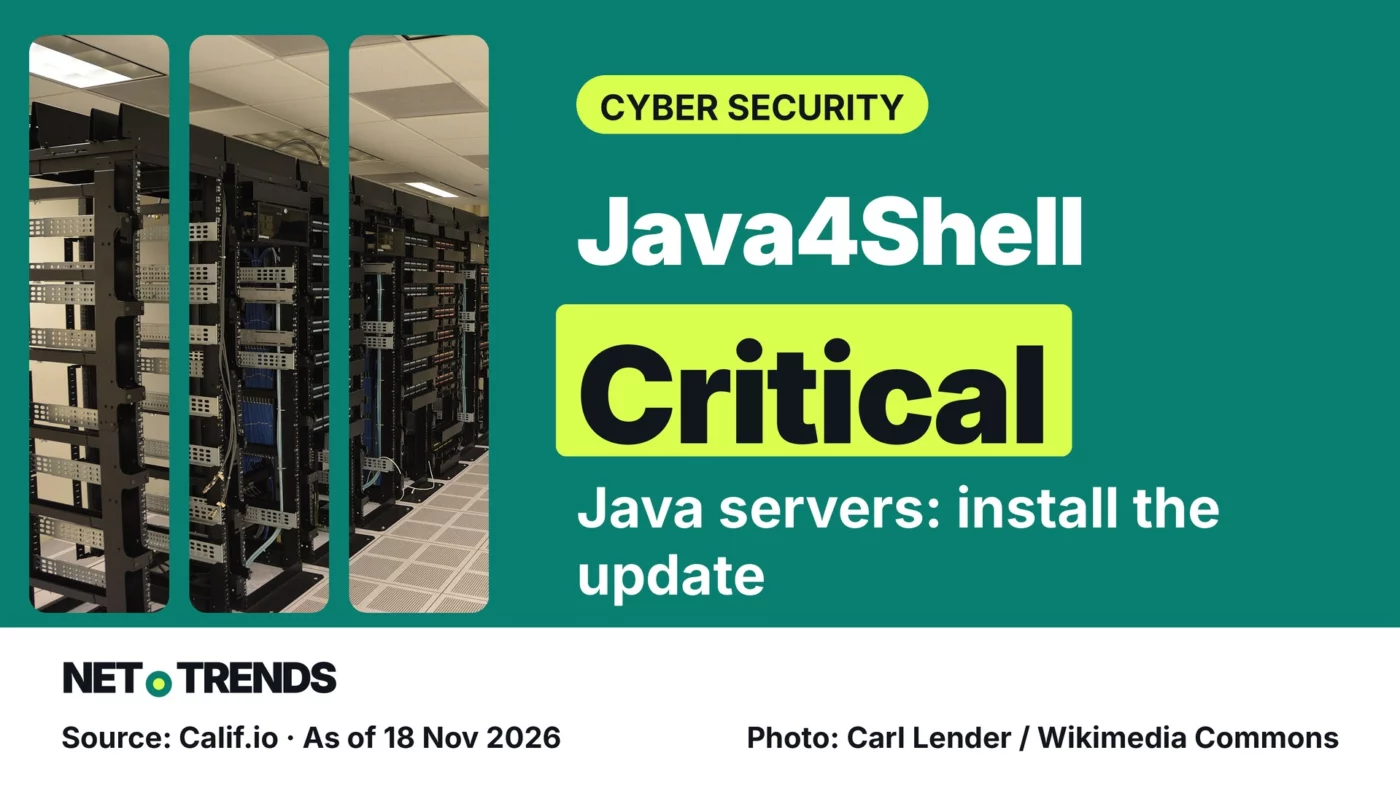
A bug in Java’s Base64 decoder can let attackers run code on servers without logging in. Oracle shipped fixes on 17 November.
Key points
- The flaw CVE-2026-114938, dubbed “Java4Shell”, sits in OpenJDK’s Base64 decoder and was disclosed by Calif.io on 17 November 2026.
- The researchers rate it 9.2 out of 10 under CVSS 4.0 and say OpenJDK 17.0.6 and later is affected, but only on x86-64 processors with AVX-512 VBMI.
- Oracle published fixed builds on 17 November 2026; the Canadian Centre for Cyber Security is not aware of active exploitation.
- If you cannot patch straight away, the JVM flag -XX:-UseBASE64Intrinsics switches off the affected code path.
A critical flaw in Java’s Base64 decoder, known as Java4Shell (CVE-2026-114938), can let attackers run code on servers without logging in. It affects Java 17 and later on processors with AVX-512 VBMI, and patches are out.
Any UK organisation running Java itself, or using software with Java built in, should treat the warning as urgent. The examples tested by the researchers are mostly server applications used in many British businesses and public bodies, from Jira and Confluence to Jenkins and Keycloak.
What Java4Shell lets attackers do
The bug is in the Base64 decoder that Java uses to turn text-encoded data back into bytes. According to the technical write-up by Calif.io, a fast routine for processors with AVX-512 VBMI miscalculates the length and write mask at the end of the input. The result is a write outside the intended memory area.
The researchers say a crafted input of 64 characters followed by “=” is enough to trigger it. From there they demonstrate memory leaks and remote code execution. Their own score is 9.2 under CVSS 4.0, which counts as critical; the rating comes from the researchers, not from a UK authority.
The Canadian Centre for Cyber Security describes the issue as a heap-based buffer overflow that can be triggered remotely without authentication. Possible consequences include memory corruption, disclosure of sensitive information, crashes or code execution.
Who is affected: servers with AVX-512 VBMI
The flaw needs an x86-64 processor with the AVX-512 VBMI instruction set extension. Calif.io names Intel Xeon from Ice Lake onwards (Ice Lake, Sapphire Rapids, Emerald Rapids, Granite Rapids) and AMD EPYC and Ryzen from Zen 4 onwards. ARM64 systems are not affected.
In default configurations the researchers achieved code execution without logging in on Keycloak, Atlassian Jira, Atlassian Confluence, JFrog Artifactory, Jenkins and PingFederate. With a login it worked on Apache Kafka brokers, Apache Solr, Elasticsearch, Gerrit and Spinnaker. Java programs that open a TLS connection to a malicious server are also at risk. The list is not exhaustive.
OpenJDK-based distributions are affected too, including Amazon Corretto, Eclipse Temurin, Microsoft’s build, Azul Zulu, BellSoft Liberica, SAP SapMachine and Red Hat’s builds.
The Java builds that contain the fix
Oracle’s Critical Patch Update for November 2026 credits the two Calif.io researchers. The Canadian Cyber Centre lists the following Oracle builds as the versions to move to. For other distributions, check your vendor’s own advisory.
| Java line | Fixed build |
|---|---|
| Oracle Java SE 8 | 8u511b33-perf |
| Oracle Java SE 17 | 17.0.21.0.3 |
| Oracle Java SE 21 | 21.0.13.0.3 |
| Oracle Java SE 25 | 25.0.5.0.3 |
| Oracle Java SE 27 | 27.0.1.0.3 |
| Oracle GraalVM for JDK | 17.0.21.0.3, 21.0.13.0.3 |
Builds listed in the alert of 17 November 2026. Source: Canadian Centre for Cyber Security, as of 18 November 2026.
One open question remains. The researchers speak of OpenJDK 17.0.6 and later, while Oracle’s list also includes a Java 8 performance build. Whether older lines are affected is not clear from the sources we checked, so anyone running Java 8 should ask their vendor rather than assume they are safe.
How the disclosure unfolded
The research, the patch and the first government warning all landed on the same day. That leaves administrators little lead time.
Java4Shell: from disclosure to fix
Calif.io discloses Java4Shell
The researchers publish their analysis of CVE-2026-114938 and rate it 9.2 under CVSS 4.0.
Oracle releases fixed builds
The Critical Patch Update for November 2026 contains corrected Java SE and GraalVM builds.
Canadian Cyber Centre issues alert AL26-029
It lists the fixed builds and reports no known active exploitation.
Calif.io has published a harmless proof-of-concept that only writes inside a test array. The researchers say they are holding back product-specific attack chains until users have had time to patch.
How to check and protect your systems
The Canadian Cyber Centre advises organisations to start with an inventory of every Java runtime, including vendor and full build version, and to put internet-facing systems first. Third-party products, appliances and containers that bundle Java belong on that list too.
To see whether a Linux server’s CPU has the relevant instructions, the researchers say the output of lscpu must show the flags avx512f, avx512bw, avx512vbmi and bmi2. If an update is not possible straight away, both sources name a stopgap: the flag -XX:UseAVX=2 disables AVX-512 on x86-64 machines, and the researchers add -XX:-UseBASE64Intrinsics. Applications that cannot be patched and face the internet should be cut off from public networks until a fix is in place.
Organisations in the UK can report a suspected compromise to the National Cyber Security Centre via its incident reporting service.
Frequently asked questions
Am I affected as a home user?
The researchers mainly describe server software. On the client side they mention Java programs that connect over TLS to a malicious server. A processor with AVX-512 VBMI is also required.
How do I check whether my processor has AVX-512 VBMI?
On Linux, the output of lscpu must contain the flags avx512f, avx512bw, avx512vbmi and bmi2, according to the researchers.
Is Java4Shell already being exploited?
The Canadian Centre for Cyber Security said on 17 November 2026 that it was not aware of active exploitation. A harmless test exploit is public; product-specific attack chains are being held back.
What if I cannot update straight away?
The sources name the JVM flags -XX:-UseBASE64Intrinsics or -XX:UseAVX=2 (x86-64 only) as a stopgap. Internet-facing applications should be isolated from public networks where possible.
Your view: Do you know which Java versions run on your organisation’s servers, and how quickly can you roll out a patch like this one? Tell us about your experience in the comments.
Sources and date
- Calif.io: Java4Shell (CVE-2026-114938), technical analysis (security research, 17 November 2026)
- Canadian Centre for Cyber Security: Alert AL26-029, critical vulnerability impacting Oracle Java (alert, 17 November 2026)
- Oracle: Critical Patch Update Advisory, November 2026 (advisory, 17 November 2026)
- National Cyber Security Centre: Report a cyber incident (service page)
As of: 18.11.2026
Transparency note: AI-assisted tools were used in researching, structuring and writing this article. The sources used are listed in the article. Publication takes place only after manual editorial approval.
Share this article

Comment Tell us what you think →