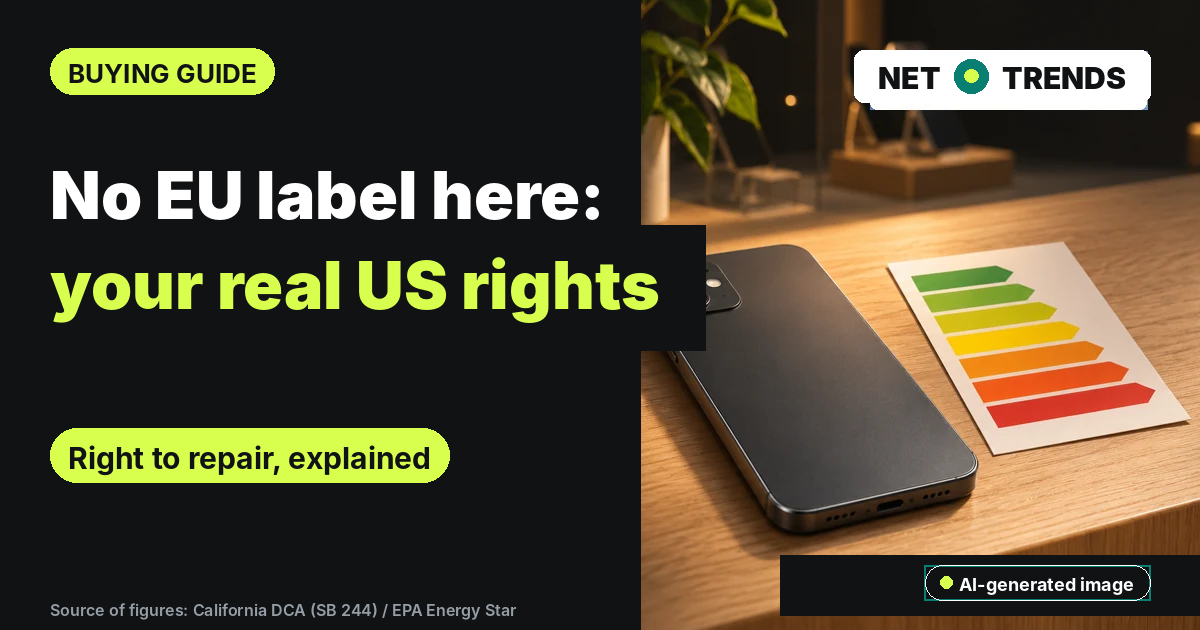
The EU now puts battery life, drop resistance and repairability on a single smartphone label. The US has no federal equivalent — but state right-to-repair laws give American buyers a different, real tool.
Key points
- Since June 2025, the EU requires smartphones sold there to carry an A-to-G energy label covering battery life, charge cycles, repairability, drop resistance and water/dust protection.
- The US federal government has no matching mandatory label: the Energy Star program, run by the EPA and Department of Energy, does not currently cover smartphones.
- Several US states have instead passed right-to-repair laws covering electronics, led by California’s SB 244 (Right to Repair Act), in effect since 1 July 2024, requiring manufacturers to make parts, tools and manuals available.
- This article explains what the EU label shows (relevant if you import a device or compare international reviews) and what actually protects US buyers today.
Shoppers who only compare price, camera and storage can miss how long a phone will realistically last and whether it can be repaired at all. In the EU, a new sticker now answers that in one glance – in the US, the answer comes from state law, not a label on the box.
This piece sets out the EU label for context, since many international model comparisons reference it, and then focuses on what actually applies if you are buying a smartphone in the United States today.
Is there a US smartphone energy or repairability label?
No federal one. ENERGY STAR, the efficiency-labeling program run jointly by the US Environmental Protection Agency (EPA) and Department of Energy, covers many electronics categories, but it does not currently certify or label smartphones the way the EU’s new A-to-G scheme does. There is no US federal equivalent of the EU’s battery-life, repairability and drop-resistance sticker.
Instead, consumer protection for smartphone durability and repair in the US comes mainly from state-level right-to-repair legislation, and from the Federal Trade Commission’s (FTC) long-standing position against warranty terms that illegally tie coverage to using only the manufacturer’s own repair service.
The strongest state law so far is California’s Right to Repair Act, SB 244, which took effect on 1 July 2024. It requires manufacturers of electronics and appliances to make service parts, tools and documentation available to owners and independent repair shops on fair terms – for seven years after manufacturing ends for products costing $100 or more. Oversight sits with California’s Department of Consumer Affairs (Bureau of Household Goods and Services). Minnesota, Colorado, Oregon and New York have passed related right-to-repair laws with varying scope; coverage and enforcement differ by state.
What the EU label shows, for comparison
Because many phones sold in the US are the same models sold in Europe, understanding the EU label is still useful when comparing international reviews or imported devices – even though it carries no legal weight in the US.
| EU label figure | What it shows | US relevance |
|---|---|---|
| Energy efficiency class A to G | Standardised EU ranking of energy efficiency | Not shown on US retail listings; no US equivalent class |
| Battery life per charge | Hours and minutes in a defined EU test routine | Useful for comparing EU model specs; US listings use manufacturer-reported figures instead |
| Battery endurance in charge cycles | EU test value until capacity drops to 80% | EU ecodesign rules require at least 800 cycles for covered phones; no matching US federal requirement |
| Repairability class A to E | EU score against a defined repairability index | No US federal equivalent; state right-to-repair laws instead mandate parts/tools access, not a public score |
| Drop resistance A to E | Result of an EU standardised drop test | Not required or displayed on US retail listings |
| IP rating | Dust/water protection under EU test conditions | Often voluntarily disclosed by manufacturers in the US too, via marketing materials |
Why the EU label doesn’t apply here
EU regulations take effect only within the EU/EEA market; they are not binding on devices sold in the United States, even when it’s physically the same phone model. US buyers comparing specs sheets internationally may still see EU battery-life and repairability figures referenced in reviews, but US retailers are under no legal obligation to disclose them.
California’s SB 244: the real US equivalent, with limits
SB 244 requires manufacturers to provide, on fair and reasonable terms, the parts, tools, and documentation needed to diagnose, maintain, or repair covered electronics and appliances, for seven years after the last unit of a model was manufactured (three years for products costing $50–$99.99; products under $50 are exempt). It applies to products first sold in California on or after 1 July 2021. Unlike the EU repairability class, it does not produce a public A-to-E score – it mandates access, and compliance is checked case by case, not pre-certified on a label.
Other states – Minnesota (effective 2024), Colorado, Oregon and New York – have passed their own right-to-repair statutes with different scopes and exemptions; a right available in one state is not automatically guaranteed nationwide. Advocacy groups such as US PIRG publish annual manufacturer scorecards (their 2026 ‘Failing the Fix’ report), which are useful context but are not government enforcement data.
Energy efficiency and battery claims: still largely self-reported
Without ENERGY STAR coverage or an FTC-mandated label for smartphones, US buyers mostly rely on manufacturer-published battery-life and efficiency figures, plus independent reviews. These are not produced under the standardised EU test protocol, so EU and US battery-life numbers for the same phone model are not always directly comparable.
Right to repair in the US: what California’s law requires
Under SB 244, a California consumer or independent repair shop can request documentation, parts and tools from a covered manufacturer on fair and reasonable terms. The law does not require manufacturers to publish a public repairability score the way the EU does; it requires that access exist and be reasonably priced, enforced through California’s Department of Consumer Affairs.
A practical approach for US buyers: check whether the brand has a public self-repair or parts program (several major manufacturers launched one following state right-to-repair laws), look up independent repairability assessments (such as iFixit’s teardown scores, which are independent journalism, not a government label), and ask retailers directly about battery replacement cost and availability before buying.
If you live outside California, Minnesota, Colorado, Oregon or New York, your state may not yet have a right-to-repair law for electronics; in that case, access to parts and manuals depends entirely on the manufacturer’s own policy, not a legal guarantee.
What neither the EU label nor US law guarantees
Even in the EU, the label doesn’t rate camera quality, signal reception, display quality or ease of use, and it doesn’t confirm software compatibility with your needs. In the US, the absence of a federal label means these questions – plus battery life and repair cost – rest even more heavily on independent reviews and the retailer’s own disclosures.
A right-to-repair law guarantees access to parts and documentation on fair terms; it does not guarantee a specific repair price, nor does it rate how durable or energy-efficient a given model actually is. Treat state right-to-repair coverage as a legal floor, not a quality score.
Checklist before you buy
Five steps before you buy a smartphone in the US
- Check whether the manufacturer offers a public self-repair or parts program in the US.
- Look up independent repairability scores (e.g. teardown-based assessments) rather than relying on marketing claims.
- Ask the retailer or manufacturer for battery life figures and how they were measured, since no standardised US test applies.
- If you live in California, Minnesota, Colorado, Oregon or New York, check your state’s specific right-to-repair coverage and exemptions.
- For imported or international models, check whether an EU energy label is shown, and treat it as extra information, not a US guarantee.
This order matters especially for budget or carrier-subsidized phones: check repairability and parts access first, since a cheap phone that can’t be repaired cheaply may cost more over time than a pricier, more durable one.
Frequently asked questions
Does the US have a smartphone energy label like the EU’s?
No. ENERGY STAR does not currently cover smartphones, and there is no federal equivalent of the EU’s A-to-G battery, repairability and drop-resistance label.
What is the closest US equivalent to the EU repairability score?
State right-to-repair laws, led by California’s SB 244 (effective 1 July 2024), which require manufacturers to provide repair parts, tools and documentation on fair terms – but without a public A-to-E score.
Does SB 244 apply if I live outside California?
Not directly, though manufacturers often extend the resulting parts and documentation programs nationwide for practical reasons. Minnesota, Colorado, Oregon and New York have their own separate right-to-repair laws with different terms.
Can I rely on an EU energy label if I see one on an imported phone?
It can be useful extra information about battery life and repairability, but it is not a US legal requirement or guarantee, since EU rules do not apply to sales made outside the EU/EEA.
Sources and status
- California Department of Consumer Affairs, Bureau of Household Goods and Services: SB 244 industry advisory
- ENERGY STAR (EPA/Department of Energy): certified product categories
- European Commission: smartphones and tablets – EU label scope and values, for comparison
- European Product Registry for Energy Labelling, EPREL (EU reference database)
Research and data as of 15 November 2026. State right-to-repair coverage changes frequently; check your own state’s current law before relying on it.
Transparency note: AI-assisted tools were used in researching, structuring and writing this article. The sources used are listed in the article. Publication takes place only after manual editorial approval.
Share this article
Comment Tell us what you think →