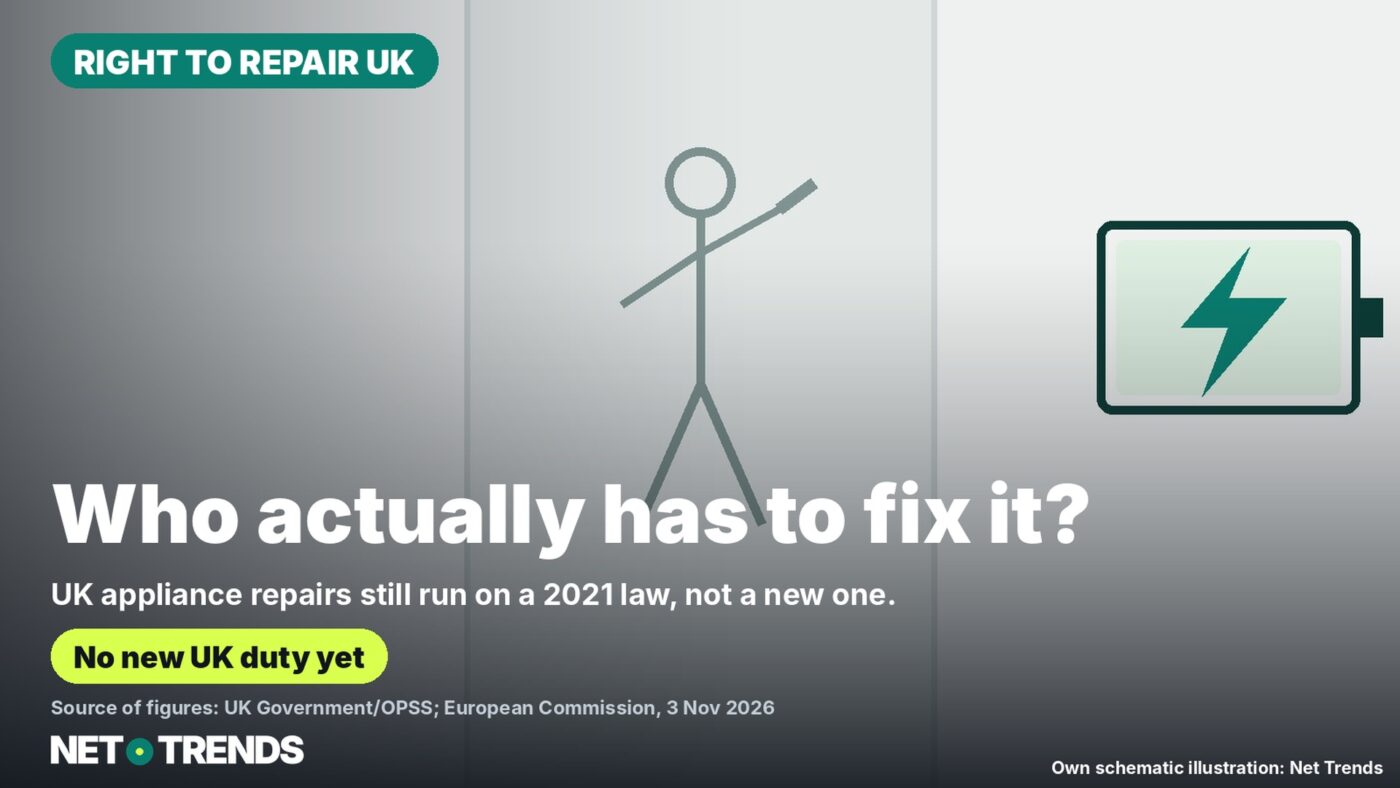
Britain’s appliance repair duties still run on the 2021 Ecodesign Regulations, enforced by OPSS, as the EU consults until 2027.
Key points
- UK repair duties for appliances such as washing machines, dishwashers, fridges and TVs come from the Ecodesign for Energy-Related Products and Energy Information Regulations 2021, enforced in Great Britain by the Office for Product Safety and Standards (OPSS).
- The UK government is updating these rules product by product rather than introducing one new law; a 2026 consultation on local space heaters proposed 10 years of spare-parts availability and faster repair-information access.
- The EU opened a new consultation on 3 November 2026 on possible further repairability rules for electronics, e-bikes and small appliances, but any resulting EU law would not automatically apply in Great Britain.
Britain’s repair rules for appliances still rest on the 2021 Ecodesign Regulations, enforced by OPSS, with no single new UK law in sight. Meanwhile, the EU is consulting on tougher repair rules until February 2027.
Unlike the EU’s rolling Ecodesign for Sustainable Products Regulation, the UK has no single, overarching “right to repair” statute. Instead, repair obligations sit inside product-specific ecodesign rules that Great Britain kept largely unchanged after leaving the EU, then updates one product category at a time as the old EU-derived standards come up for review.
Northern Ireland is a partial exception: under the Windsor Framework, it continues to follow new EU ecodesign law directly, while Great Britain only updates its own regulations when the UK government decides to.
What the 2021 Ecodesign Regulations already require
The Ecodesign for Energy-Related Products and Energy Information Regulations 2021 (SI 2021/745) already set out repair duties for several household appliance categories, including washing machines, dishwashers, refrigerating appliances and electronic displays such as televisions.
Under Schedule 19, manufacturers, importers or their UK representatives must give professional repairers access to repair and maintenance information no later than two years after a model first goes on sale. Suppliers must publish online how repairers can register, must accept or refuse a registration request within 5 working days, and must then supply requested repair information within 1 working day.
That information must include things such as disassembly diagrams, lists of repair and test equipment, component and diagnosis data, wiring diagrams and diagnostic fault codes. Suppliers may charge a fee, but it must be “reasonable and proportionate” and not act as a deterrent to independent repairers using it.
Who enforces it: OPSS
The Office for Product Safety and Standards (OPSS), part of the UK government’s business department, is the appointed market surveillance authority for ecodesign regulations in both Great Britain and Northern Ireland, according to official government guidance. OPSS can investigate non-compliant products and publishes its enforcement actions, including cases brought under ecodesign and energy information rules, in periodic reports.
Responsibility for setting new ecodesign standards themselves currently sits with the Department for Energy Security and Net Zero (DESNZ), which runs the technical consultations that update individual product categories.
A 2026 example: the space heater consultation
Rather than a single UK-wide reform, the clearest sign of where British repair policy is heading in 2026 is a DESNZ consultation on updating minimum energy performance standards for local space heaters, published on 25 March 2026 and now closed.
Its “right to repair” section proposed, among other things, that manufacturers of covered heaters supply spare parts such as controls, thermostats, heating elements and circuit boards for at least 10 years, ship those parts within 10 working days of an order, provide repair information to approved installers within 1 working day, and process a professional repairer’s registration request within 5 working days. The proposal would apply only in Great Britain, since Northern Ireland follows the equivalent EU rule under the Windsor Framework.
DESNZ’s own assessment put one-off familiarisation costs in 2027, with any phase-out of non-compliant heaters starting the same year, and said the UK would review the rule no later than five years after it takes effect. The consultation shows the model the UK is using: not one new “right to repair” act, but incremental, product-by-product updates that broadly track what the EU has already required under its own rules, as summarised in official options assessment published by DESNZ.
Where the EU stands now
On 3 November 2026, the European Commission opened a public consultation on possible future repairability requirements under the Ecodesign for Sustainable Products Regulation (EU) 2024/1781. It runs until 9 February 2027 and is gathering views on spare parts, repair information, software and firmware rules, disassembly and repairability scores, with consumer electronics, light means of transport such as e-bikes, and small household appliances provisionally in scope. No new obligations have been decided yet; any delegated act is only expected to go forward for adoption in 2027.
Because the UK is no longer an EU member state, any rule that eventually comes out of this process would not automatically apply in Great Britain. It would, however, still bind EU-based retailers selling into the single market, and UK manufacturers that export appliances to the EU would need to meet it for those products regardless of what British law requires at home.
What this means for UK shoppers and repairers
For now, a UK buyer of a new washing machine, dishwasher, fridge or television already has a legal basis, via the 2021 regulations, to expect that an independent repairer can eventually get hold of spare parts and repair information for it – though the two-year window before that access must begin, and the lack of a fixed spare-parts stocking period in those general rules, leaves gaps that campaigners have criticised.
Whether those gaps close any time soon depends on DESNZ’s product-by-product consultations, such as the space heater proposal, rather than on what Brussels eventually decides for the EU single market.
Frequently asked questions
Does the UK have a general right-to-repair law like the EU’s?
No single UK statute covers all products. Repair duties instead sit inside product-specific rules under the Ecodesign for Energy-Related Products and Energy Information Regulations 2021, which Great Britain updates category by category.
Who enforces UK ecodesign and repair rules?
The Office for Product Safety and Standards (OPSS) is the market surveillance authority for ecodesign regulations in Great Britain and Northern Ireland, according to official government guidance, while the Department for Energy Security and Net Zero sets new standards.
Will the EU’s new consultation change UK law?
Not automatically. The UK is not an EU member, so a future EU repairability rule from the Ecodesign for Sustainable Products Regulation would not apply directly in Great Britain, though it would still affect UK exporters selling into the EU market.
Sources and status
- The Ecodesign for Energy-Related Products and Energy Information Regulations 2021, Schedule 19 (legislation.gov.uk)
- Placing energy-related products on the UK market – OPSS guidance (gov.uk)
- Updating minimum energy performance standard for local space heaters – options assessment (DESNZ, gov.uk)
- Commission launches consultation on easier product repairs, 3 November 2026 (European Commission)
- Regulation (EU) 2024/1781 (Ecodesign for Sustainable Products Regulation, EUR-Lex)
Research and data as of: 10 November 2026.
Transparency note: AI-assisted tools were used in researching, structuring and writing this article. The sources used are listed in the article. Publication takes place only after manual editorial approval.
Country edition based on an article from Net Trends, researched for the UK.
Own schematic illustration, not AI-generated.
Share this article