DVSA recall affects certain electric Volkswagens built 2022 to 2025 over high-voltage battery fire risk
Key points
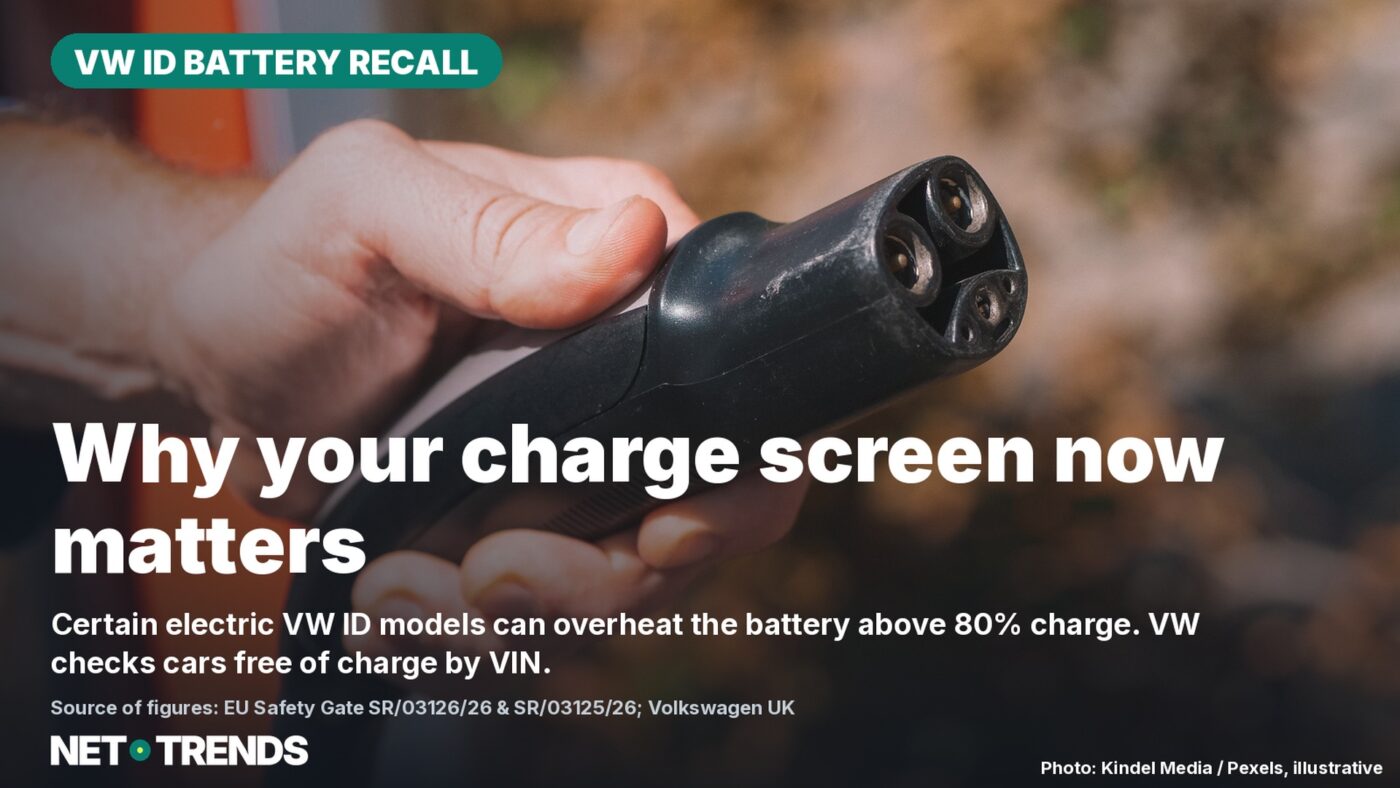
- The EU’s Safety Gate alert system lists two recall notices, SR/03126/26 and SR/03125/26, for certain Volkswagen ID.3, ID.4, ID.7 and ID. Buzz models over possible high-voltage battery overheating.
- Volkswagen’s safety actions are coded 93MF and 93MV. Owners of an affected car are told to charge to no more than 80% until it has been checked.
- Whether a specific car is affected cannot be judged from the model or year alone. What counts is the Vehicle Identification Number (VIN), which a Volkswagen retailer or the free DVSA recall checker can match.
On certain electric Volkswagens from the ID range, the high-voltage battery can overheat if it is charged above 80%. Volkswagen’s safety actions 93MF and 93MV cover affected ID.3, ID.4, ID.7 and ID. Buzz models built between July 2022 and June 2025. For owners, two things matter now: keep to the 80% charge limit, and check the recall status using the car’s Vehicle Identification Number (VIN).
The notices do not cover an entire model line, and not automatically every car from a given production year. Certain vehicles may have battery components that do not meet the required specification. Model name and production period are only a first clue — Volkswagen can give a reliable answer only via the 17-digit VIN.
Two safety actions, several ID models
Safety Gate, the European Commission’s rapid alert system for dangerous products, lists alert SR/03126/26 for the ID.3, ID.4, ID.7, and ID. Buzz People and ID. Buzz People Cargo. The manufacturer’s code for this action is 93MF, with a stated production period from 13 July 2022 to 6 June 2025.
A second notice, SR/03125/26, covers certain ID.4 and ID.7 models under action 93MV, with a production period from 18 September 2023 to 27 June 2025. The two periods overlap but cover different groups of vehicles, so a car cannot be safely included or ruled out purely by its first registration date.
In Great Britain, the DVSA (Driver and Vehicle Standards Agency) runs the free online tool “Check if a vehicle, part or accessory has been recalled”, which lets owners search by registration number or VIN across all UK vehicle recalls recorded since 1992. As with the German KBA database, a result there only reflects the details entered — because often only certain drivetrains, trims or battery batches are affected, the exact status should still be confirmed with Volkswagen or an authorised dealer using the VIN.
A high charge level raises the overheating risk
Volkswagen UK’s own safety information on actions 93MF and 93MV describes the core issue: in some high-voltage batteries from a particular supplier, components may fail to meet quality requirements. If an affected battery is charged above 80%, it could overheat, creating a fire risk with the potential for serious injury and significant property damage.
Volkswagen UK states that no confirmed injuries are known, though there have been isolated cases of vehicle damage. This is the manufacturer’s own account and is not proof that every affected car already has a fault — the defect is said not to be reliably detectable from the outside, which is why all vehicles covered by the actions are to be checked.
Practical safety rule
- Set your charge target to 80% or below until your car has been checked.
- Do not bypass a charge limit the car has already applied itself.
- If a yellow battery warning appears, contact your Volkswagen retailer promptly.
- If you see smoke or fire, stop, pull over in the open if possible, switch off the ignition, leave the vehicle and call 999.
According to Volkswagen, the 80% limit reduces strain on the high-voltage battery and increases the safety margin. It applies to the maximum charge level, not the charging method: rapid DC charging remains possible in principle, provided the 80% limit is not exceeded. For cars registered in Great Britain, the recall letter from Volkswagen and the instructions of your retailer take precedence over general guidance.
VIN, not registration year, decides
The VIN appears on the car’s registration document (V5C) and is usually also visible at the base of the windscreen. Owners should have it ready and ask a Volkswagen retailer about actions 93MF and 93MV. Anyone who has already received a recall letter should follow the steps it sets out and book the requested appointment.
Volkswagen says many affected cars have already had their maximum charge capacity limited to 80% remotely, provided the car is online; depending on settings, this may not yet have taken effect. Owners can check in the infotainment system or the We Connect app whether the charge target can still be set above 80%. If an affected car has not received the limit, the Battery Care mode should be switched on manually in the meantime.
A letter not having arrived yet is not a good reason to ignore a relevant warning. Address changes, a change of keeper or simple delivery delays can affect when letters arrive — a direct VIN check with a franchised dealer is the most reliable way to find out.
What applies until your appointment
Volkswagen considers continued use acceptable in principle as long as the charge limit is respected. That is not a general clearance for every fault: if a warning light comes on, or you notice an unusual smell, excessive heat, smoke or other abnormal signs, the car should not simply continue to be used. In that situation, the in-car display, the Volkswagen service network, and if necessary the fire brigade, are the right points of contact.
Anyone who lends the car out or shares it within the family should make sure every driver knows about the charge limit. A sticker or marking applied as part of the recall should not be removed. Especially before a longer trip, it is worth checking appointment availability, since the temporary limit reduces usable range.
Checks, software and possible battery work
According to Volkswagen, the condition of the high-voltage battery is assessed first. If the check finds no issue, the temporary charge limit can be lifted once the check is successfully completed. Where irregularities are found, the limit remains in place until the affected battery modules have been replaced.
Volkswagen also refers to a software update that can be part of the process. Depending on the vehicle, a physical battery check is required, and battery modules are replaced where necessary. Once all required work is finished, the original charge capacity and usual range should be restored. The manufacturer describes the work carried out under the action as free of charge. The specific remedy and time needed depend on the individual vehicle.
In Great Britain, vehicle recalls sit within the wider framework of UK product and vehicle safety law, overseen by the DVSA for road vehicles and by the Office for Product Safety and Standards for general product safety; manufacturers are expected to take remedial action where a vehicle presents a serious risk. Whether a buyer additionally has a claim against a seller depends on the purchase contract, the vehicle’s age and the specific fault — the recall itself does not decide that separate consumer-law question.
Frequently asked questions
Can I keep driving an affected VW ID?
Volkswagen considers continued use acceptable in principle if the battery is charged to no more than 80% and there is no warning light or other abnormal sign. The recall letter you receive, and the instructions of your Volkswagen retailer, take precedence.
Which models are named in the two EU alerts?
Certain ID.3, ID.4, ID.7 and ID. Buzz People / ID. Buzz People Cargo vehicles are named. Whether a specific car is affected is decided by its VIN, not the model name alone.
What do the codes 93MF and 93MV mean?
These are Volkswagen’s internal codes for the two safety actions. They help when searching the DVSA recall checker or asking a dealer.
Does the 80% charge limit stay in place for good?
No. According to Volkswagen, once the check and any necessary work are complete, the original charge capacity and range should be restored.
What has your experience been?
Have you received a letter about 93MF or 93MV, and how quickly could your dealer offer a check-up slot? Share your experience in the comments without posting your full VIN or other personal details.
Sources and status
- GOV.UK / DVSA: Check if a vehicle, part or accessory has been recalled
- European Commission: Safety Gate, notice SR/03126/26
- European Commission: Safety Gate, notice SR/03125/26
- Volkswagen UK: safety information on actions 93MF and 93MV
Research and data as of: 7 November 2026.
Transparency note: AI-assisted tools were used in researching, structuring and writing this article. The sources used are listed in the article. Publication takes place only after manual editorial approval. Country edition based on an article from Net Trends, researched for the United Kingdom.
Share this article