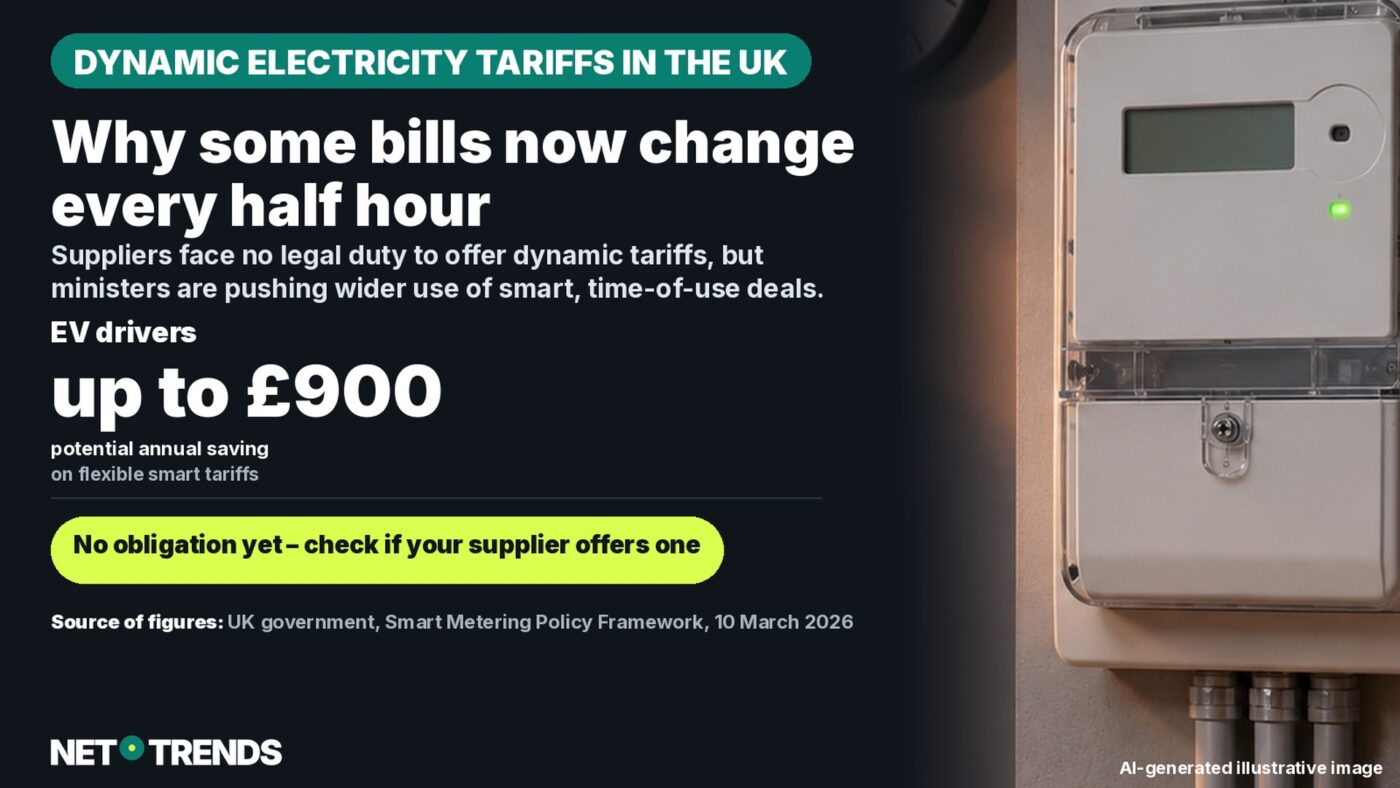
Unlike Germany, UK suppliers face no legal duty to offer dynamic electricity tariffs. Smart, time-of-use deals such as Octopus Agile exist, and ministers want them to grow – but taking one up is still optional.
Key points
- Germany requires all suppliers to offer a dynamic tariff from 2025. Great Britain has no equivalent legal requirement for suppliers.
- Smart, time-of-use tariffs such as Octopus Agile already exist on the market and require a smart meter.
- The UK government’s Smart Metering Policy Framework, published 10 March 2026, urges suppliers to expand smart-tariff offers rather than mandating them.
If you are comparing a dynamic electricity tariff in the UK with what you have read about Germany’s mandatory offer, the comparison does not quite hold. No UK supplier is legally required to offer a dynamic, half-hourly priced tariff – though several already do, and government policy is pushing for more.
This article sets out what actually applies in Great Britain, what a smart tariff can save you, and what to check before switching.
Why there is no UK obligation
Great Britain has no legislation comparable to Germany’s § 41a EnWG, which forces every electricity supplier to offer a dynamic, exchange-linked tariff from 2025. Ofgem, the UK energy regulator, sets licence conditions and service standards for suppliers, but it does not require them to sell a specific tariff type.
Instead, the government has taken a promotional approach. Its Smart Metering Policy Framework consultation response, published 10 March 2026, says the Clean Power 2030 Mission is expected to increase demand for smart tariffs and urges suppliers to “make full use of” the opportunities this creates, including smart-contingent tariffs and related incentives – without imposing a legal duty to offer one.
What smart, time-of-use tariffs offer
Several suppliers already sell dynamic or time-of-use tariffs that change the unit rate through the day, most notably Octopus Energy’s Agile tariff, which tracks half-hourly wholesale prices. According to the government’s policy document, flexible electricity users – for example electric vehicle drivers who charge overnight – can save up to £900 a year on suitable smart tariffs. That figure is an illustrative maximum from the government’s own material, not a guarantee for every household.
Because take-up is voluntary, the range of dynamic tariffs, their pricing formulas and their terms vary significantly between suppliers. Comparing the full pricing formula, not just an advertised saving, remains essential.
The smart meter you need
A dynamic or time-of-use tariff requires a smart meter capable of recording consumption at half-hourly intervals. Ofgem’s Final Decision on Smart Metering Guaranteed Standards of Performance, published 30 January 2026, sets service standards and compensation rules for the smart meter rollout, but concerns installation quality, not a right to a particular tariff. The ongoing Market-wide Half Hourly Settlement (MHHS) programme is expected to improve the accuracy of half-hourly billing across the market, though the government document gives no fixed completion date.
How this compares with Germany
Germany’s § 41a EnWG, in force since 1 January 2025, obliges every electricity supplier to offer a dynamic tariff to customers with a smart meter, regardless of supplier size. Britain has chosen a different path: no legal mandate, but government pressure on suppliers to expand voluntary smart-tariff offers as part of the wider Clean Power 2030 agenda. For now, whether you can get a dynamic tariff in the UK depends on which supplier you are with, not on a legal right.
Frequently asked questions
Is my UK electricity supplier required to offer a dynamic tariff?
No. Unlike in Germany, there is no legal duty for UK suppliers to offer a dynamic or time-of-use tariff. Some suppliers, such as Octopus Energy, offer one voluntarily.
Do I need a smart meter for a dynamic tariff?
Yes. A dynamic or time-of-use tariff requires a smart meter that records consumption at half-hourly intervals.
How much could I save on a smart tariff?
According to UK government material, flexible users such as EV drivers who charge overnight could save up to £900 a year. This is an illustrative maximum, not a guaranteed saving for every household.
Is the government planning to make dynamic tariffs compulsory?
The Smart Metering Policy Framework response of 10 March 2026 encourages suppliers to expand smart-tariff offers but does not set out a legal requirement to do so.
Sources and status
- UK government: Smart Metering Policy Framework post-2025, government response, published 10 March 2026, accessed 5 November 2026.
- Germany: Energiewirtschaftsgesetz, § 41a (for comparison, in German), accessed 5 November 2026.
Research and data as of: 5 November 2026.
Transparency note: AI-assisted tools were used in researching, structuring and writing this article. The sources used are listed in the article. Publication takes place only after manual editorial approval. This is a country edition based on an article from Net Trends, researched for the United Kingdom. Original image note: AI-generated illustrative image.
Share this article