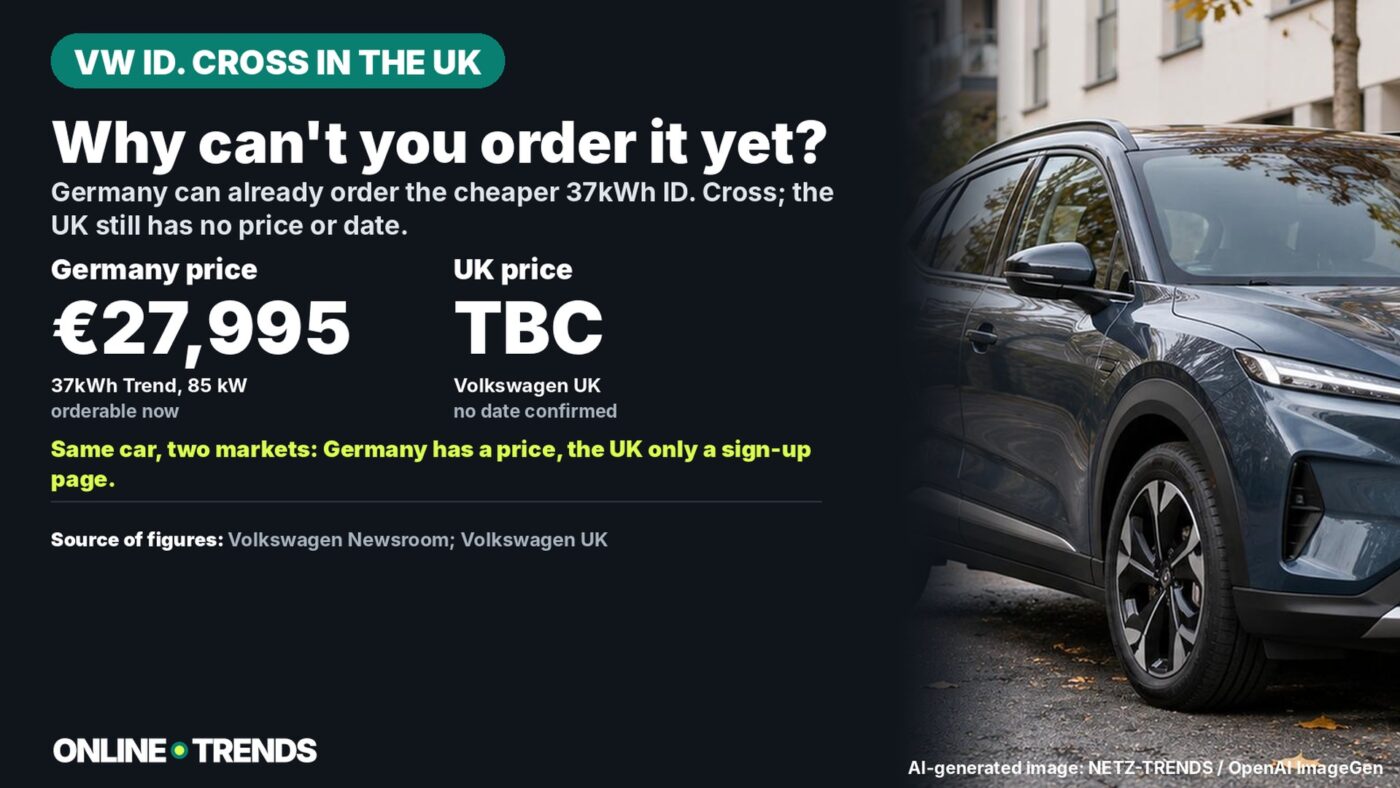
Volkswagen’s entry-level ID. Cross with a 37kWh battery now starts at €27,995 in Germany – but as of 2 November 2026 Volkswagen UK has not yet confirmed a GBP price or an on-sale date for this version.
Key points
- In Germany, the ID. Cross Trend with the new 37kWh battery and 85kW motor is orderable from €27,995, with up to 324 km of WLTP range and 10–80% DC charging in about 23 minutes, Volkswagen says.
- Volkswagen UK’s own ID. Cross page currently shows only the larger 52kWh battery, with a provisional “up to 271 miles” WLTP figure for the Style trim – no UK price and no launch date have been published.
- The ID. Cross is already listed as eligible for the UK government’s Electric Car Grant, at the £1,500 tier – even though its list price is still shown as “TBC” (to be confirmed).
- Grant eligibility requires a list price under £37,000; independent UK estimates (not an official Volkswagen figure) put a possible entry price somewhere around £25,000–£28,000.
Volkswagen has started pre-sales in Germany of a cheaper ID. Cross with a smaller 37kWh battery, priced from €27,995 as a Trend with 85kW. UK buyers, however, cannot yet order this version, or any ID. Cross: Volkswagen UK has published only a provisional 52kWh specification and has not confirmed a price in pounds or an on-sale date.
The figures below come from Volkswagen’s own English-language press release on the 37kWh ID. Cross and from Volkswagen UK’s ID. Cross page. They are manufacturer figures, not an independent road test.
What the entry version costs in Germany
Volkswagen prices the ID. Cross Trend with the new 37kWh (net) battery and 85kW (116PS) motor from €27,995 including German VAT. The smaller battery sits below the 52kWh version offered at launch, and the 37kWh pack is also available with a 99kW (135PS) motor. Trim levels are Trend, Life and Style, mirroring the line-up already shown on other European Volkswagen sites.
This is a German list price for a specific entry-level configuration; options and market-specific taxes change the final figure, and Volkswagen has not published equivalent pricing for the UK.
Why UK buyers are still waiting
Volkswagen UK’s ID. Cross page, live as of 2 November 2026, advertises only a “new 52kWh battery” with a provisional WLTP figure of “up to 271 miles” for the top Style trim without options – the smaller 37kWh battery sold in Germany is not mentioned for the UK market. The page gives no price and states that the UK’s “recommended On The Road price” (which bundles delivery, registration, first-year Vehicle Excise Duty and 20% VAT) is still to be set; it only invites visitors to register to “keep me informed” ahead of the car’s arrival.
That leaves a gap between the two markets: the ID. Cross had its world premiere in mid-July 2026 and is already orderable in Germany, while UK specification and pricing remain unconfirmed.
What a 324 km WLTP range means
Volkswagen’s 324 km figure for the German 37kWh version is a WLTP laboratory rating, used across the EU and the UK to allow like-for-like comparisons between cars rather than to predict real-world range on any single journey. Temperature, speed, terrain, load and the use of heating or air conditioning all affect how far a car actually travels.
Volkswagen UK’s own provisional figure for the larger 52kWh battery – “up to 271 miles” (about 436 km) – is not directly comparable to the German 37kWh number, since it is a different battery, a different trim, and still described as provisional pending finalised WLTP data.
Charging: 10–80% in about 23 minutes
For the 37kWh version, Volkswagen quotes a maximum DC charging power of 90kW, with a 10–80% charge taking around 23 minutes under suitable conditions. That is a manufacturer figure for one specific charging window; state of charge, battery temperature and the power of the charger used can all change the real time taken. Volkswagen UK’s page does not yet give separate charging figures for the market.
The Electric Car Grant: listed, but priced “TBC”
Even without a confirmed UK price, the ID. Cross already appears on the government-linked list of models eligible for the UK’s Electric Car Grant, in the £1,500 discount tier – with its list price shown as “TBC” rather than a figure. The grant, run by the Department for Transport, generally requires a car’s list price to stay under £37,000 (or under £42,000 for a version sharing the same battery and motor as a qualifying model), and pays either £1,500 or £3,750 depending on the vehicle’s environmental and battery-sourcing score.
Independent UK estimates – not Volkswagen figures – have suggested an entry-level ID. Cross could cost somewhere between roughly £25,000 and £28,000 once it reaches UK showrooms, depending on specification and whether it qualifies for the higher grant tier. Until Volkswagen UK confirms pricing, that remains an estimate rather than a fact.
Frequently asked questions
Can I order the 37kWh VW ID. Cross in the UK?
Not yet, as of 2 November 2026. The 37kWh version is orderable in Germany from €27,995, but Volkswagen UK’s page only shows the larger 52kWh battery, with no price or on-sale date confirmed.
How far can the German 37kWh ID. Cross travel on one charge?
Volkswagen states up to 324 km (WLTP) for the 37kWh version. WLTP figures are for comparing vehicles and do not guarantee any individual journey’s range.
Does the ID. Cross qualify for the UK Electric Car Grant?
It is listed as eligible at the £1,500 tier, though its list price is still marked “TBC”. Grant eligibility generally requires a list price under £37,000.
How fast does it charge?
For the 37kWh version, Volkswagen quotes 10–80% DC charging in about 23 minutes at up to 90kW, under suitable conditions. This is a manufacturer figure, not an independent test result.
Sources and status
- Volkswagen Newsroom: Affordable and versatile: ID. Cross can now be ordered with a 37kWh battery.
- Volkswagen UK: ID. Cross model page, viewed 2 November 2026.
- Which?: Electric Car Grant: all eligible models and other brand discounts.
- The Car Expert: New electric Volkswagen ID. Cross revealed (UK price estimate, not an official figure).
Research and data as of 2 November 2026.
Transparency note: AI-assisted tools were used in researching, structuring and writing this article. The sources used are listed in the article. Publication takes place only after manual editorial approval. Country edition based on an article by Net Trends, researched for the UK. Original image note: AI-generated image.
Share this article