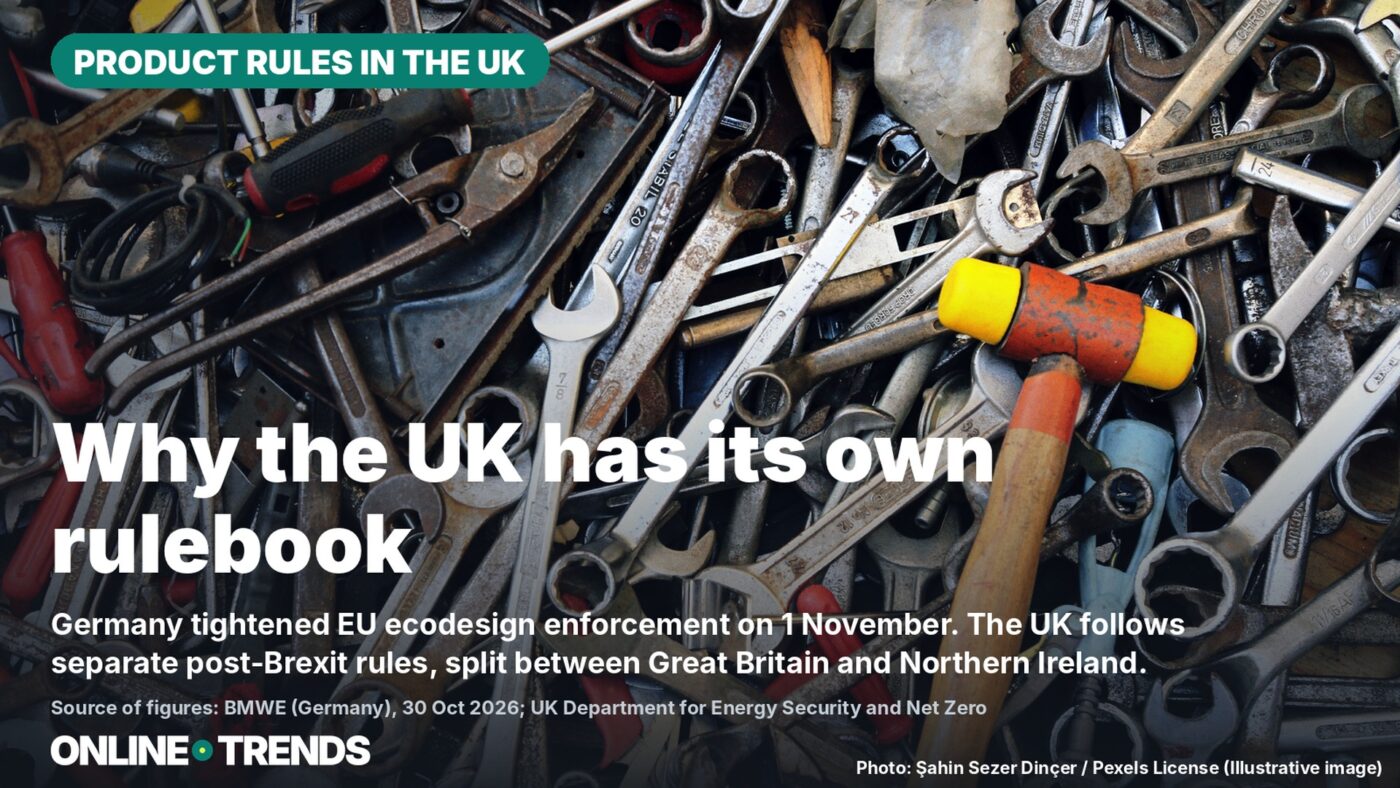
Germany tightened enforcement of EU ecodesign and energy label rules on 1 November. The UK left the EU ecodesign system after Brexit and now runs its own, separately updated rulebook.
Key points
- Germany’s Ecodesign Act took effect on 1 November 2026, tightening enforcement of existing EU requirements and giving qualified repairers a legal right to spare parts and repair information.
- The UK is not in the EU’s ecodesign system. Great Britain (GB) uses its own “assimilated” versions of the old EU rules, while Northern Ireland (NI) still follows current EU rules.
- The Office for Product Surveillance and Standards (OPSS) is the market surveillance authority for ecodesign in GB and NI, covering around 35 product categories.
- OPSS updated its enforcement guidance twice in 2026, including repairability information options added on 8 April 2026.
Germany tightened enforcement of its existing EU ecodesign and energy label rules on 1 November 2026. The UK runs a separate system after Brexit, so the German change has no direct effect here – but the underlying theme, easier access to repair information, is live in Britain too.
Shoppers in the UK still see the familiar A-to-G energy label on many appliances, and most of the roughly 35 product categories covered look similar to the EU list. The legal basis, however, is now separate: Great Britain and the EU have been diverging since Brexit, and the German law passed on 1 November changes nothing here.
What changed in Germany on 1 November
Germany’s Ecodesign Act (OekodesignG) took effect on 1 November 2026 alongside changes to its energy labelling law. The reform tightens enforcement of ecodesign and energy labelling requirements that already existed under EU law, rather than creating new EU-wide standards. Its main new feature is a legal right for qualified repair businesses to obtain spare parts and repair information, where the relevant EU product rule already provides for this. The law applies only in Germany.
GB and NI: two different rulebooks
Because of Brexit, UK ecodesign law has split in two. Great Britain uses “assimilated” versions of older EU regulations – the ones in force when the UK left the single market for these rules – such as the 2012 and 2015 rules for tumble dryers and local space heaters. Northern Ireland, by contrast, continues to follow current EU regulations, including newer 2023 and 2024 rules for the same product categories. In practice, this means an appliance can be compliant in Belfast under rules that a retailer in Manchester does not yet have to follow, or vice versa.
Who enforces ecodesign rules in the UK
The Office for Product Safety and Standards (OPSS) is the appointed market surveillance authority for ecodesign in both GB and NI. It covers around 35 product categories, from washing machines and dishwashers to lighting, televisions and water heaters. Manufacturers, authorised representatives or importers placing a product on the market must hold a declaration of conformity and keep technical documentation for at least ten years, ready to hand to OPSS within ten working days on request. Products need a UKCA or CE mark for GB, and a CE mark for NI.
Repair information: 2026 updates in GB
OPSS updated its GB enforcement guidance twice in 2026. On 27 January 2026 it refreshed the list of products and legislation in scope. On 8 April 2026 it added labelling and product-sheet options that include repairability information, as part of ongoing easements for tumble dryers and local space heaters while the government consults on whether GB should align more closely with current EU rules. The Department for Energy Security and Net Zero (DESNZ) has told OPSS not to enforce against CE-marked products that already meet the newer EU rules, pending that consultation.
What this means when you buy an appliance
For shoppers, the practical effect is limited: energy labels still have to be accurate, and OPSS can act against retailers who get them wrong. What has changed is mainly technical and regional – which exact rulebook a given appliance is certified against, and whether that is the GB or the NI version. If you care about repairability, it is worth asking the retailer or manufacturer directly whether spare parts and repair instructions are available, since UK rules do not yet set out a general right to this information in the way Germany’s new law does for products covered by the relevant EU rule.
Frequently asked questions
Does Germany’s new Ecodesign Act apply in the UK?
No. It only tightens enforcement of EU ecodesign rules inside Germany. The UK left the EU ecodesign system after Brexit and runs its own GB and NI rulebooks.
Who checks energy labels and ecodesign compliance in the UK?
The Office for Product Safety and Standards (OPSS) is the market surveillance authority for around 35 product categories in GB and NI.
Do GB and Northern Ireland follow the same rules?
No. GB uses older “assimilated” EU rules frozen at the point of Brexit, while NI continues to follow current EU regulations, including more recent updates.
Is there a UK right to repair like Germany’s new law?
Not a general one. OPSS added repairability information options to some GB labelling easements in April 2026, but this is narrower than the access right in Germany’s Ecodesign Act.
Have you tried to get spare parts or repair information for a UK appliance recently? Tell us how it went in the comments.
Sources and status
- UK Government: Placing energy-related products on the UK market.
- German Federal Ministry for Economic Affairs and Energy: New ecodesign and energy labelling rules take effect (in German), 30 October 2026.
- Germany’s Ecodesign Act: official text (in German), notably Section 15.
Research and data as of: 2 November 2026.
Transparency note: AI-assisted tools were used in researching, structuring and writing this article. The sources used are listed in the article. Publication takes place only after manual editorial approval. Country edition based on a Net Trends article, researched for the UK.
Share this article