At Alphabet and Meta, free cash flow tipped into negative territory – German suppliers such as Infineon feel the share-price swings too.
Key points
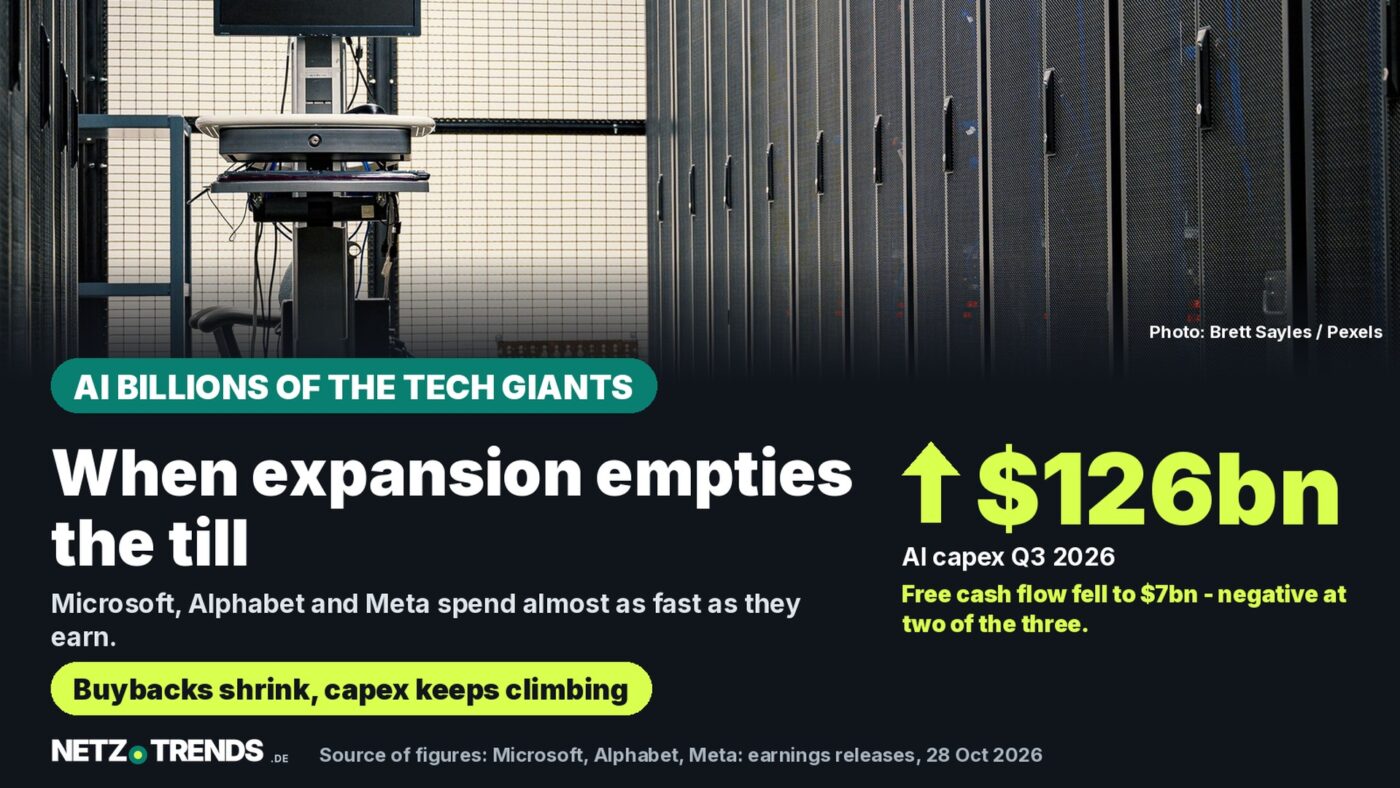
- Microsoft, Alphabet and Meta invested a combined $125.7 billion in servers, chips and data centers in their latest quarterly results.
- Free cash flow was negative at Alphabet and Meta. Alphabet bought back no shares of its own in the quarter and instead raised fresh capital through bonds and a share issue.
- Microsoft’s cloud division Azure grew 48 percent, Alphabet’s Google Cloud even 103 percent – demand for computing power for artificial intelligence remains high.
- German suppliers such as Infineon and Siemens Energy react sensitively on the stock market to the US tech giants’ investment mood; Deutsche Telekom and Nvidia have been operating their own AI data center in Munich since February 2026.
Microsoft, Alphabet and Meta together spent $125.7 billion on servers and data centers in their latest quarterly results. At two of the three companies, that left virtually no free cash flow on the bottom line.
All three US companies reported their results within a few days of each other in October 2026: Meta on 21 October, Microsoft and Alphabet both on 28 October. The same finding appears in all three reports, just with varying force: spending on data centers, graphics processors and cooling technology is growing faster than income from ongoing business, even though revenue itself is also rising strongly.
For readers in Germany, this is more than a footnote from Wall Street: millions of savers indirectly hold stakes in exactly these three companies through world ETFs and pension funds, and German suppliers of chips and energy technology are increasingly tied to the same investment cycle.
Microsoft: record profit despite higher spending
Microsoft reported revenue of $92.3 billion for the first quarter of its 2027 fiscal year (July to September 2026), up 19 percent. Profit under US accounting standard GAAP rose 32 percent to $36.6 billion, or $4.92 per share.
At the same time, the company spent $39.4 billion on capital expenditure, mainly data centers and servers. Operating cash flow stood at $58.0 billion, leaving around $18.6 billion in free cash flow. Share buybacks were lower at $4.4 billion than the previous quarter’s $5.7 billion, plus $6.8 billion in dividends. The Azure cloud division grew 48 percent to $33.2 billion in revenue.
“We are delivering our customers more capability, choice, control and cost efficiency across the full stack.”
Satya Nadella, CEO of Microsoft Corporation (MSFT), in the quarterly statement of 28 October 2026
Alphabet: no share buybacks for the first time
At Google parent Alphabet, the picture is more pronounced. Revenue rose 25 percent to $127.6 billion in the third quarter of 2026, with profit at $26.5 billion. Earnings per share nonetheless fell from $2.87 to $2.12.
The reason is investment: in the third quarter alone, Alphabet spent $51.4 billion on capital expenditure, and $132.0 billion combined in the first nine months of 2026. That compared with just $42.3 billion in operating cash flow in the third quarter – producing free cash flow of minus $9.1 billion. Over the trailing twelve months, a cushion of $19.7 billion remains, but Alphabet bought back not a single share of its own in the third quarter of 2026, compared with $11.5 billion a year earlier. Instead, the company raised $12.4 billion through issuing new shares and $28.7 billion via a bond. The Google Cloud division grew 103 percent to $30.7 billion in revenue.
Meta: more revenue, less left over
Meta Platforms published its figures as early as 21 October 2026. Revenue rose 26 percent to $64.6 billion, and earnings per share rose from $1.05 to $3.83. The increase masks the underlying trend: operating income fell 37 percent because Meta booked a $9.89 billion charge from a settlement with 52 US state attorneys general. The fact that earnings per share still rose was due to a lower tax burden: it came in at $3.14 billion, significantly lower than the $18.95 billion booked in the same quarter a year earlier.
On investment, the picture confirms what rivals are seeing: $34.91 billion in capex compared with $32.79 billion in operating cash flow, producing free cash flow of minus $2.12 billion – a year earlier it was still plus $10.63 billion. Meta bought back no shares of its own in the quarter. For the full year 2026, the company expects investment of $135 to $145 billion, and for 2027 Meta announced further rising spending without naming a specific figure.
What this means for Germany
Germany’s benchmark index, the DAX, is reacting to the US investment wave too. Infineon and Siemens Energy, which supply chips and energy technology for data centers, were among the DAX stocks with the biggest daily swings in October 2026 whenever new figures or doubts about the profitability of AI investment emerged. SAP, meanwhile, tends to benefit from the trend as a cloud partner to the US companies.
Some of the infrastructure being reported on here is also being built in Germany: Deutsche Telekom and Nvidia brought a joint AI data center with around 10,000 Nvidia graphics processors into operation in February 2026, in a former bank data center beneath Munich’s Tucherpark. Both companies put the investment volume at around one billion euros, with partners including SAP and Agile Robots. Telekom CEO Tim Höttges justified the project, according to the federally owned foreign trade agency Germany Trade & Invest (GTAI), with the aim of keeping customer data in Germany.
For savers, the development rarely arrives directly, but rather by way of their own investments: Microsoft, Alphabet and Meta are among the largest holdings in popular world ETFs that many Germans use to save for retirement. If the share price of the three companies swings sharply, that feeds straight through to portfolio value.
Costly transformation or a bubble?
Whether the high spending pays off is disputed among market observers. Proponents point to the growth rates of the cloud divisions: Azure rose 48 percent, Google Cloud as much as 103 percent – both figures well above growth at the companies overall. That suggests at least part of the new computing capacity is already in use rather than being built on spec.
Critics counter that falling or absent share buybacks, along with rising bond and share issuance, are a warning sign: when companies increasingly finance their investment through fresh debt and equity rather than from ongoing business, dependence on favorable financing conditions in capital markets grows. The quarterly figures alone do not provide solid evidence of an “AI bubble” in the strict sense – that is, systematically overvalued assets without underlying economic value; for that, the billions in investment would first have to generate returns over years that justify their cost.
What matters now
- If cloud revenue (Azure, Google Cloud) keeps growing significantly faster than the companies overall, that points to capacity being used rather than excess capacity.
- If free cash flow stays negative at several companies over several quarters, dependence on bonds and fresh equity will grow.
- Changes in share buybacks and dividends signal early how much the investment is already curbing payouts to shareholders.
- German supplier stocks such as Infineon and Siemens Energy often mirror sentiment on this topic faster than the US stocks themselves.
This is not investment advice, but a classification of publicly reported figures. Anyone invested in individual stocks or funds should seek independent advice for specific decisions.
Frequently asked questions
Why are Microsoft, Alphabet and Meta suddenly spending so much more on AI?
All three companies attribute the high investment to demand for cloud and AI computing power. Microsoft’s Azure grew 48 percent, Google’s cloud division even 103 percent – both companies report that existing capacity is not enough to meet all the demand.
Does negative free cash flow mean these companies are in financial trouble?
Not necessarily. Operating cash flow remained high to very high at all three companies. Free cash flow turns negative because a large share of it is immediately reinvested in new data centers. It becomes a problem only if companies can permanently finance themselves solely through debt and new shares.
What do German stocks like Infineon or Siemens Energy have to do with this?
Both companies supply chips or energy and cooling technology needed to build AI data centers. Their share prices therefore react sensitively to any news about the US tech giants’ investment mood.
Does Deutsche Telekom operate its own AI data center?
Yes. Together with Nvidia, Telekom brought an AI data center with around 10,000 Nvidia graphics processors into operation in Munich in February 2026, with an investment volume of around one billion euros.
Sources and status
- Microsoft Corporation: Quarterly statement for the first quarter of fiscal year 2027, 28 October 2026 (microsoft.com/Investor)
- Alphabet Inc.: Earnings release, third quarter 2026, 28 October 2026 (abc.xyz, PDF)
- Meta Platforms, Inc.: Quarterly statement, third quarter 2026, 21 October 2026, SEC Form 8-K (sec.gov)
- Germany Trade & Invest (GTAI): “ITC Giants Pair to Build Massive Sovereign German Data Center”, 5 November 2025 (gtai.de)
Research and data as of: 31 October 2026.
Transparency note: AI-assisted tools were used in researching, structuring and writing this article. The sources used are listed in the article. Publication takes place only after manual editorial approval. This article is a translation of the German original published on NETZ-TRENDS.de.