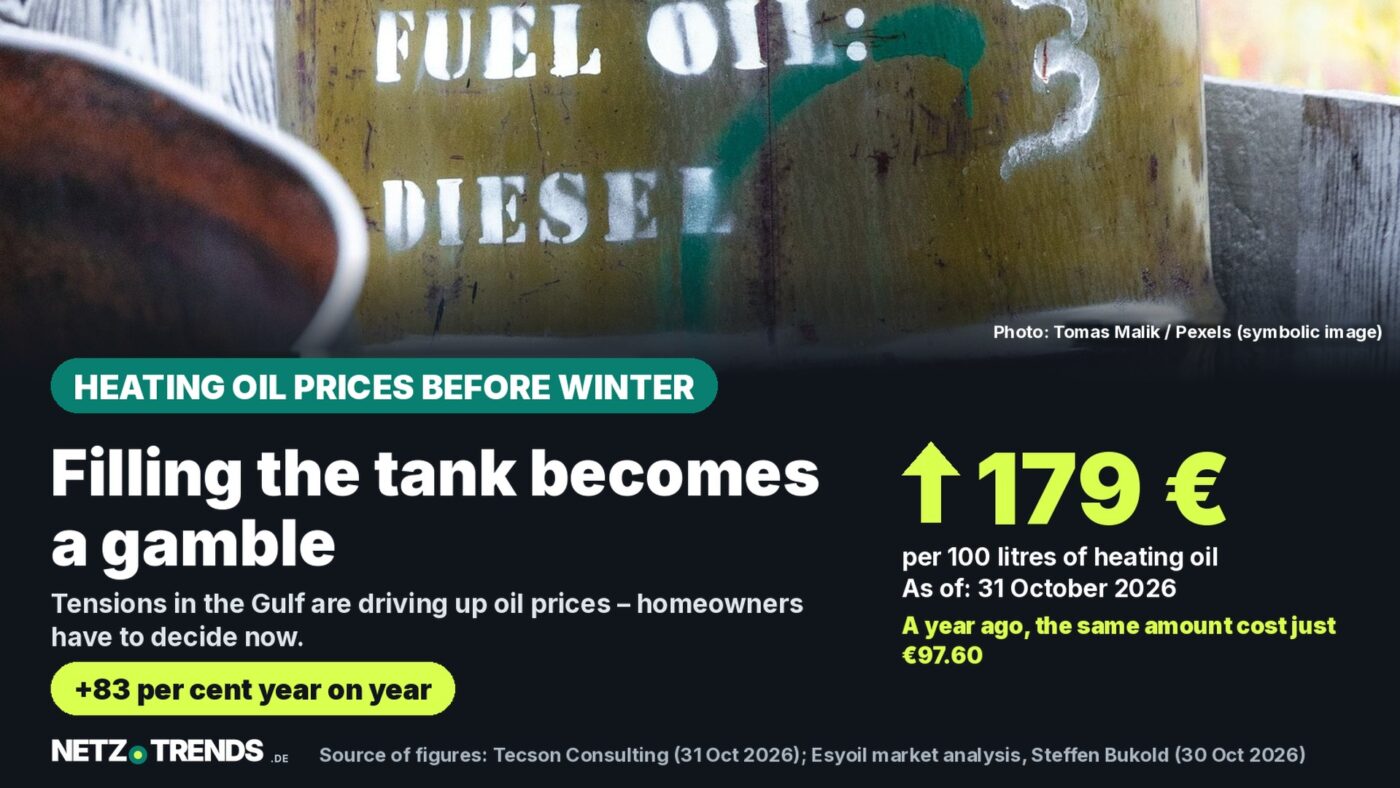
Tensions in the Gulf have driven up the oil price by 13 per cent since September – what this means for homeowners before the winter.
Key points
- On 31 October 2026, heating oil in Germany costs an average of €179.00 per 100 litres nationwide – 83.4 per cent more than a year ago, according to the daily index of Tecson.
- The price of Brent crude oil has risen by around 13 per cent since September, driven by incidents in the Strait of Hormuz and attacks on Saudi oil facilities, according to oil market analyst Steffen Bukold of Esyoil.
- A standard delivery of 3,000 litres currently costs around €5,370 – roughly €2,442 more than a year ago.
- Compared with the previous week, the price has fallen slightly (−0.4 per cent), but compared with the previous month it has continued to rise (+2.8 per cent).
Heating oil in Germany is more expensive than it has been for years. On Saturday, the standard delivery cost €179.00 per 100 litres according to the Tecson index – 83 per cent more than a year ago.
The main driver is the rising price of crude oil: Brent stood at 117.22 US dollars per barrel on Friday, just below its high for the year in April, as oil market analyst Steffen Bukold of Esyoil noted. The reason is a series of incidents on one of the world’s most important oil transport routes, which are fuelling fears of supply disruptions.
For homeowners in Germany who want to fill up their tank before the winter, this means that deciding whether to buy now or wait is particularly difficult this autumn.
€179 per 100 litres: the situation today
The nationwide average price for a standard delivery of 3,000 litres of heating oil stood at €179.00 per 100 litres, including value added tax, on Saturday, 31 October 2026, according to the daily index of market observer Tecson. The figure fluctuates from day to day and reflects the nationwide average – regional and supplier-specific deviations are common.
| Point in time | Price per 100 litres | Change to today |
|---|---|---|
| Today (31 October 2026) | €179.00 | — |
| One week ago (24 October) | €179.70 | −0.4% |
| One month ago (end of September) | €174.10 | +2.8% |
| One year ago (31 October 2025) | €97.60 | +83.4% |
Source: Tecson Consulting, heating oil price index for Germany, as of 31 October 2026. Figures for a standard delivery of 3,000 litres including value added tax.
The table shows that the big jump is not in the past week but in the year-on-year comparison. Within twelve months, the price per litre has almost doubled.
Why oil is so expensive right now
In Germany, the heating oil price largely follows the world market price for crude oil, converted via refining costs, taxes and trading margins. According to Esyoil market analyst Steffen Bukold, Brent stood at 117.22 US dollars per barrel on Friday and the US benchmark WTI at 103.98 US dollars. Compared with a month earlier, this means an increase of around 13 per cent.
Bukold cites as reasons several incidents in the Strait of Hormuz, one of the world’s most important tanker routes, including a tanker that was hit, as well as attacks by Yemen’s Houthi militia on Saudi oil facilities in Ras Tanura, Rabigh and Abqaiq. In his assessment, there are also concerns about a possible new attack by the United States on Iran. On the other hand, a pause in Ukrainian drone attacks on Russian refineries and an expansion of Russian diesel exports announced for November recently had an easing effect.
According to Bukold, large producers are also benefiting from the high prices: he points to a significantly higher quarterly profit at the British oil company BP. NETZ-TRENDS had no independent confirmation of the exact profit figure at the time of going to press.
What a full tank costs now
Sample calculation: a standard delivery of 3,000 litres
- Price today: 3,000 litres × €1.79 per litre = €5,370
- Price a year ago: 3,000 litres × €0.976 per litre = €2,928
- Difference: €5,370 − €2,928 = €2,442 more
Model calculation based on the nationwide Tecson average price of 31 October 2026 and of 31 October 2025. Actual prices vary depending on region, delivery quantity, payment method and supplier – the calculation does not reflect any individual contract.
For a detached house with an annual consumption of around 3,000 litres, the current price therefore means additional costs of several hundred euros compared with the previous month and more than €2,400 compared with the previous year – an amount that directly strains the heating budget for the coming season in many households.
Buy now or wait?
No general purchase recommendation can be derived from the current data. Although the price is slightly below the previous week’s level, it remains well above the previous month’s and, even more so, the previous year’s figure. Whether waiting pays off depends on how the geopolitical situation in the Gulf develops, which according to Bukold remains difficult to predict.
Practical checklist before ordering heating oil
- Obtain several quotes: prices often differ by several cents per litre depending on region and delivery quantity.
- Do not let the tank run completely empty, but do not rush to fill it at the day’s highest price either – comparison portals show the current daily prices.
- Allow for delivery times before the winter: during cold snaps, demand rises at short notice and delivery times get longer.
- Joint orders with neighbours can sometimes secure volume discounts.
Outlook: what comes next
In the short term, the situation remains tense in Bukold’s assessment: according to his analysis, Japan plans to gradually phase out its oil price subsidies from December, which could further affect global demand. In the medium term, a decision by the German Federal Ministry for Economic Affairs is also coming into focus: by the end of November 2026, it intends to present a draft on the so-called “Biotreppe” (bio-staircase), under which the blending quota for biodiesel is to start at 1 per cent from 2028 and be based on energy content. In Bukold’s assessment, a resulting tighter supply of biodiesel could put additional long-term pressure on the heating oil price in Germany – even if the current situation in the Gulf eases.
According to Bukold, a return to pre-crisis prices has thus been postponed time and again.
Frequently asked questions
Why is heating oil so expensive at the moment?
The price of Brent crude oil has risen by around 13 per cent since September 2026. According to oil market analyst Steffen Bukold of Esyoil, this is mainly due to several incidents in the Strait of Hormuz and attacks on Saudi oil facilities, which have fuelled fears of supply disruptions. These crude oil prices feed directly into the heating oil price in Germany.
How much does a full tank cost at the moment?
At the nationwide Tecson average price of €179.00 per 100 litres, a standard delivery of 3,000 litres costs around €5,370. A year ago, it was still around €2,928.
Has the peak already been reached?
This cannot be reliably predicted at present. The price is currently slightly below the previous week’s level, but still well above the previous month. Oil market analyst Steffen Bukold also points out that a pause in Ukrainian drone attacks on Russian refineries and an expansion of Russian diesel exports announced for November could have a dampening effect on prices.
What does the planned “Biotreppe” mean for future heating oil prices?
The German Federal Ministry for Economic Affairs intends to present a draft law on the so-called “Biotreppe” (bio-staircase) by the end of November 2026: according to this, the blending quota for biodiesel is to start at 1 per cent from 2028 and be based on energy content. In Steffen Bukold’s assessment, a resulting tighter supply of biodiesel could put additional long-term pressure on the heating oil price, even if the current geopolitical situation eases.
Sources and status
- Tecson Consulting GmbH & Co. KG: heating oil price index for Germany, retrieved on 31 October 2026.
- Esyoil GmbH, market analysis by Steffen Bukold: “Ölpreise ziehen zum Monatsende an. Ölkonzerne melden Rekordgewinne” (Oil prices rise at the end of the month. Oil companies report record profits), published on 30 October 2026.
Research and data as of: 31 October 2026.
Transparency: This article was researched and written with the support of artificial intelligence and is intended for human editorial review.