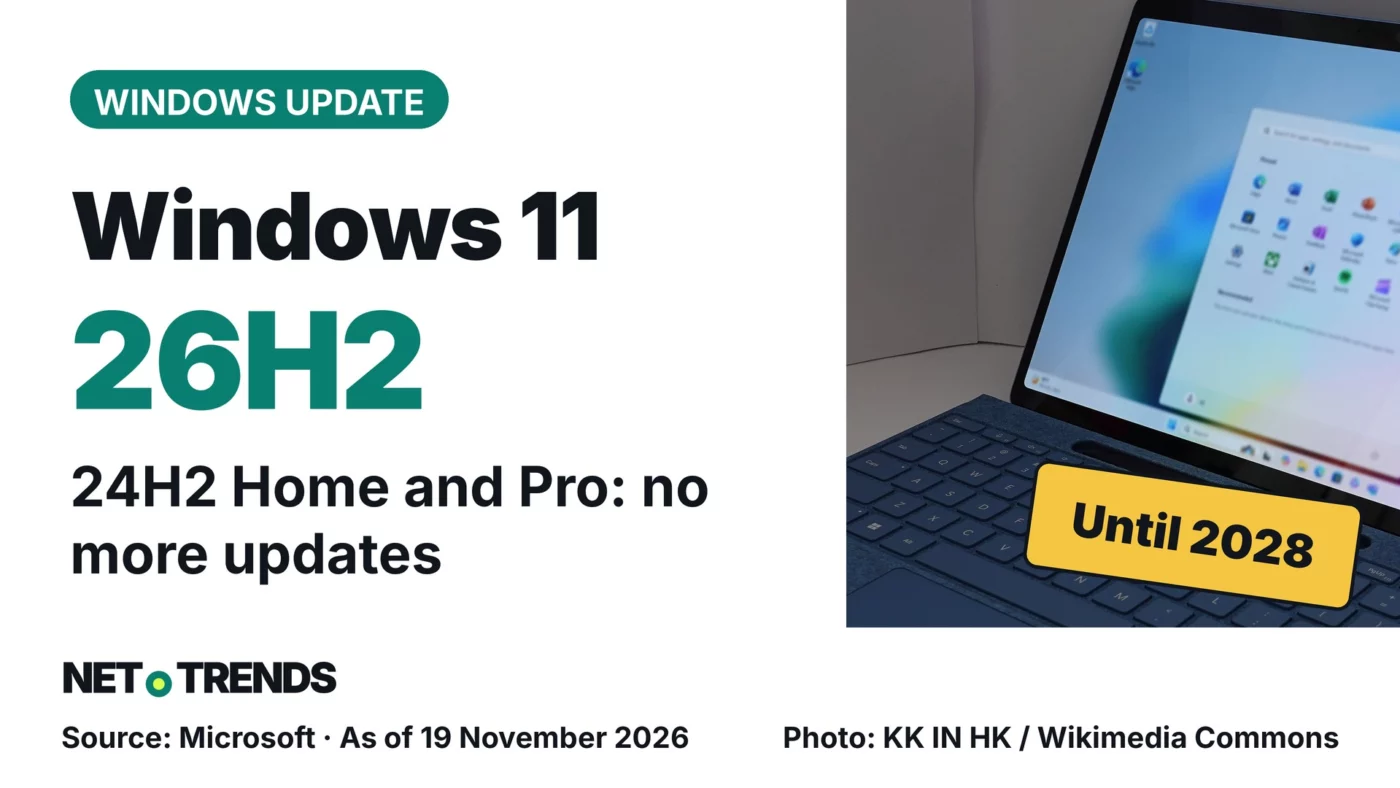
Microsoft has been pushing out 26H2 automatically since 18 November, while 24H2 on Home and Pro no longer receives updates.
Key points
- Microsoft released Windows 11 26H2 on 29 September 2026 and has been rolling it out automatically since 18 November, starting with unmanaged PCs on 24H2 and 25H2.
- In Microsoft’s release table, 24H2 Home and Pro are marked “End of updates”; Enterprise and Education keep getting updates until 12 October 2027.
- 26H2 is a small enablement package with one restart, and it resets the support clock: 24 months for Home and Pro, 36 months for Enterprise and Education.
- The release health page lists three known issues: two are resolved and one, affecting SQL Server connections, is confirmed and mainly hits businesses.
Microsoft is gradually rolling out Windows 11 26H2 to unmanaged PCs running 24H2 and 25H2. If your laptop runs 24H2 Home or Pro, it no longer gets security updates.
Microsoft sets this out on its 26H2 release health page, last updated on 19 November 2026. The page says 26H2 is available to all eligible devices; you have been able to install it manually since the end of October.
What this means for you depends on the version on your PC. Below you will find how to check it, when support ends for each version, what the update contains and which problems Microsoft has listed.
What has changed since 18 November
According to the release health page, Microsoft is widening the automatic rollout “gradually”. It starts with Windows 11 PCs on 24H2 and 25H2 that are not managed by an IT department. That covers home computers and small-business machines nobody controls centrally.
Whether your PC is offered the update also depends on your Windows Update settings. Automatic does not mean everyone gets it on the same day. If you do not want to wait, go to Settings, Windows Update and select “Check for updates”.
The Windows blog post of 29 September 2026 explains that Microsoft can apply so-called safeguard holds when it spots a compatibility problem. Affected devices are then held back for a while. As of 18 November, no such hold was listed for 26H2.
26H2 is a switch, not a rebuild
The update arrives as an enablement package. Microsoft describes it as a small update that switches on features already delivered through earlier monthly updates. It needs a single restart. This works because 26H2, 25H2 and 24H2 share the same servicing baseline.
In practice, you can install the package on 25H2 or directly on 24H2. You do not have to move to 25H2 first. Version 26H1 is different: Microsoft says it is meant for new devices from early 2026 and is not offered as an update to PCs on 24H2 or 25H2.
On content, Microsoft says little. Some features that were off by default in 25H2 are switched on by default in 26H2, but the blog post does not list them. The lifecycle page adds one limit: 26H2 is the last version to support the Snapdragon 850 processor.
Which version is on your PC?
Open Settings, then System and About. Under “Windows specifications” you will see the version, for example 24H2 or 25H2. Alternatively, press the Windows key and R, type winver and press Enter.
The edition matters too. Home, Pro, Pro Education and Pro for Workstations get 24 months of updates. Enterprise, Education and some other editions get 36 months. Most home users in the UK run Home or Pro and therefore fall under the shorter period.
When support ends for each version
The figures come from Microsoft’s Windows 11 release information, last updated on 19 November 2026. Version 26H1 is left out because it only ships on new devices.
Windows 11: when updates end for each version
| Version | Available since | Updates until (Home, Pro) | Updates until (Enterprise, Education) |
|---|---|---|---|
| 26H2 Longest support | 29 Sep 2026 | 10 Oct 2028 | 9 Oct 2029 |
| 25H2 | 30 Sep 2025 | 12 Oct 2027 | 10 Oct 2028 |
| 24H2 | 1 Oct 2024 | Ended | 12 Oct 2027 |
| 23H2 | 31 Oct 2023 | Ended | Ended |
The gap between 24H2 and 25H2 is biggest for home users. On 24H2 Home or Pro you are already without updates; on 25H2 you are covered until 12 October 2027. The lifecycle page for Windows 11 Home and Pro gives 14 October 2026 and 13 October 2027 instead. Microsoft states those dates in US Pacific Time, which may explain the one-day difference.
Installing 26H2 resets the support lifecycle. For Home and Pro that means updates until 10 October 2028, about a year more than 25H2.
Known issues: two fixed, one confirmed
As of 18 November the release health page shows three entries. Microsoft only lists open issues and entries from the past 30 days, so older problems may be missing.
- SQL Server connections: connections from linked server queries stay open and can pile up. Status “Confirmed”, caused by the update of 13 October 2026 (KB5127648). On 12 November Microsoft announced an out-of-band fix “in the coming days”.
- USB audio devices: some USB Audio Class 1.0 devices failed to start or stayed silent (Code 10). Resolved with the security update of 10 November 2026 (KB5132061).
- Remote Desktop for non-administrators: connections failed with error 0xC000000D when “Administrator protection” was on. Resolved with the update of 28 October 2026 (KB5127936).
For home users the USB audio entry matters most, for example if a USB headset went quiet after an update. The SQL Server problem mainly affects servers and company networks, though Windows 11 clients on 24H2 and 25H2 are also listed.
Businesses, schools and managed PCs
Managed devices are not part of the automatic rollout for now. Organisations get 26H2 through Windows Autopatch and the Microsoft 365 admin centre and can keep their existing management tools. Microsoft recommends pilot installs first to test apps and processes.
The pressure is lower here: 24H2 Enterprise and Education run until 12 October 2027, 25H2 until 10 October 2028. For Windows 11 Enterprise LTSC 2024, Microsoft gives 9 October 2029 as the end of mainstream support.
What you can do now
If you run 24H2 on Home or Pro, install the update soon, because no more security updates are coming. On 25H2 you have until October 2027, but switching earlier extends your support. Microsoft does not say how long the rollout will take, so do not assume you are protected while you wait.
How to go about it
- Check version and edition: Settings, System, About, “Windows specifications”.
- Back up your files.
- Open Windows Update and select “Check for updates”; if 26H2 is offered, download and install it.
- Plan for one restart.
- Afterwards, go through your settings, because some features are now on by default.
If 26H2 is not offered yet, that is not a fault. Microsoft is rolling out in stages and can hold back devices with known compatibility problems. Check again over the next few days.
Frequently asked questions
Do I need to upgrade from 24H2 to 25H2 first?
No. Microsoft says the 26H2 enablement package installs on both 25H2 and 24H2.
How long does the update take?
Microsoft gives no time. The Windows blog describes the package as small and quick and mentions a single restart.
Why can’t I see 26H2 yet?
Microsoft is rolling it out gradually and can hold back devices with known compatibility issues. No active hold for 26H2 is currently listed.
Will I get 26H1?
Only on new devices. Microsoft does not offer 26H1 as an update to PCs on 24H2 or 25H2.
Your view: Has Windows Update already offered you 26H2, or is your PC still on 24H2 or 25H2? Tell us about your experience in the comments.
Sources and date
- Microsoft: How to get the Windows 11 2026 Update (Windows blog, 29 September 2026)
- Microsoft: Windows 11, version 26H2 known issues and notifications (release health page, updated 19 November 2026)
- Microsoft: Windows 11 release information (release table, updated 19 November 2026)
- Microsoft: Windows 11 Home and Pro lifecycle (lifecycle page, accessed 23 November 2026)
As of: 23.11.2026
Transparency note: AI-assisted tools were used in researching, structuring and writing this article. The sources used are listed in the article. Publication takes place only after manual editorial approval.
Share this article