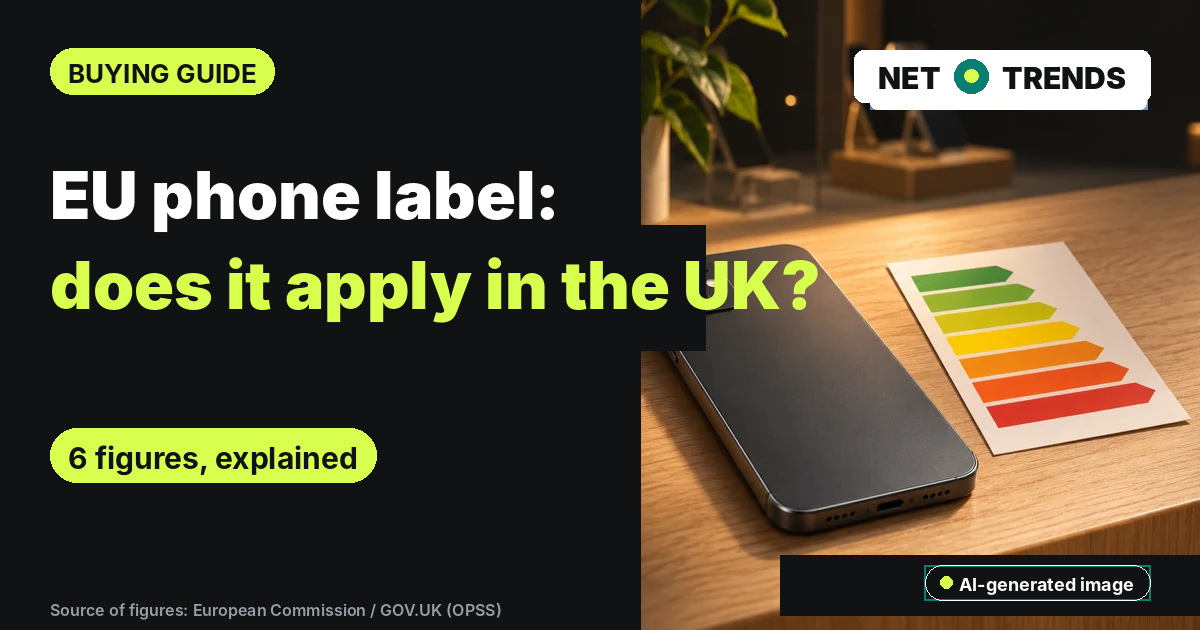
Smartphones and tablets sold in the EU now carry a battery, durability and repairability label – but UK shoppers won’t necessarily see the same A-to-G sticker. Here’s what actually applies.
Key points
- Since 20 June 2025, the EU requires an energy label on smartphones and slate tablets placed on the EU market, showing battery life, charge cycles, repairability, drop resistance and IP rating.
- The UK left the EU single market: its own retained ecodesign rules list smartphones and tablets as a product category, but the guidance published by the UK government does not confirm a matching mandatory UK A-to-G sticker scheme.
- The Office for Product Safety and Standards (OPSS) is the market surveillance authority for these rules in Great Britain and Northern Ireland; the Department for Energy Security and Net Zero (DESNZ) is the lead department.
- UK shoppers buying from retailers that also sell into the EU may still see an EU-style label on the box – but there is no confirmed independent UK legal requirement for it at the time of writing.
Shoppers who only check the price, camera and storage can miss useful information about how long a phone will last. In the EU, a new label now puts battery life, durability and repairability on one sticker – in the UK, the picture is less clear-cut.
This article sets out what the EU label actually shows, and separately what UK law currently says – rather than assuming the EU rule applies here automatically, since Brexit means it does not do so without a specific UK regulation.
Does the EU label apply to phones bought in the UK?
Not automatically. The EU’s energy label for smartphones and so-called slate tablets has applied since 20 June 2025 to devices placed on the EU market. The United Kingdom is not in the EU single market, so an EU regulation does not take direct legal effect here unless UK law separately adopts it.
UK government guidance on placing energy-related products on the UK market does list “smart phones (mobile phones, tablets etc)” among the product categories subject to the UK’s own retained ecodesign regime, and notes that such products can also be subject to separate energy information (labelling) rules. However, the guidance – last updated 8 April 2026 at the time of research – does not set out a UK A-to-G sticker matching the EU scheme, and its current announcements concern other product categories, not smartphones.
The Office for Product Safety and Standards (OPSS) is the market surveillance authority for ecodesign rules in Great Britain and Northern Ireland, with the Department for Energy Security and Net Zero (DESNZ) as the lead department. For a binding answer on whether a UK-specific energy label for smartphones exists or is planned, OPSS can be contacted directly (OPSS.enquiries@businessandtrade.gov.uk).
The six figures on the EU label, explained
Because many phones sold in UK shops are the same models sold across the EU, retailers sometimes display the EU label voluntarily, or UK buyers may see it on imported packaging. Knowing what the six EU figures mean is still useful – just bear in mind it is not a UK legal requirement.
| Figure | What it shows | What to watch for |
|---|---|---|
| Energy efficiency class A to G | Standardised ranking of energy efficiency | Read alongside the other figures; it is not a running-cost forecast |
| Battery life per charge | Hours and minutes in a defined test routine | Useful to compare models, not a prediction of your own battery life |
| Battery endurance in charge cycles | Test value until capacity drops to 80% | A higher cycle count can matter if you keep a phone for years |
| Repairability class A to E | Score against a defined repairability index | Check the QR code for the individual criteria and spare-parts availability |
| Drop resistance A to E | Result of a repeated, standardised drop test | A is the top class; it is not a guarantee against damage |
| IP rating | Protection against dust and water under defined test conditions | Check the manufacturer’s notes on depth and duration |
Efficiency class and battery life: useful, not definitive
The class runs from A to G and is a common starting point to compare the efficiency index of different models – it is not a kilowatt-hour figure or a prediction of your electricity bill. The label also shows battery life per charge in hours and minutes, measured under a standardised test: screen brightness, signal, apps and temperature all affect real-world use, so compare similar models rather than assuming you’ll match the test figure exactly.
Charge cycles and repairability: durability over years
The cycle figure shows, under the test, how many full charges the battery withstands before dropping to 80% of its rated capacity, rounded to the nearest hundred; the EU’s ecodesign rule requires at least 800 cycles with at least 80% remaining capacity for covered smartphones. The repairability class from A to E covers disassembly, fasteners, tools needed, spare parts, software updates and repair information, viewable via the QR code in EPREL – it is not a repair quote, but it highlights differences that price alone hides. The EU rule also sets minimum timeframes: critical spare parts must generally be available to professional repairers within five to ten working days and remain available for seven years after a model stops being sold; operating-system upgrades must be offered for at least five years from the last unit’s market placement. None of this is confirmed as separately enforceable under UK law for devices sold only in the UK.
Drop test and IP rating: robust figures, read with care
Drop resistance, classed A to E from a repeated standardised drop test, does not make a phone indestructible – a knock on a corner or pre-existing damage can give a different result, and a case remains a separate choice. The IP rating shows protection against dust and water under defined EU test conditions, carried out without a case; a high rating does not permit prolonged underwater use, and EPREL may list extra detail such as the tested depth.
Using the QR code and EPREL from the UK
The QR code on an EU-labelled phone leads to the European Product Registry for Energy Labelling, EPREL, which holds extra model information including the detailed repairability breakdown. UK shoppers can access EPREL like anyone else; check that the model identifier in the register exactly matches the device in your basket or on the price tag, since very similar variants can carry different figures.
A practical approach: open the label on the product or listing page, scan the QR code, and compare the model identifier. Note the figures that matter most to you – battery life, cycle count, repairability – and where models genuinely differ; if the QR code leads to a different variant or the product can’t be clearly matched, check the exact model number with the seller before ordering.
Because there is no confirmed UK-specific labelling mandate at the time of writing, UK retailers are not necessarily required to display the EU label or a UK equivalent on their own listings. If a retailer does show the EU label voluntarily, treat it as a useful extra data point rather than a guaranteed UK legal disclosure.
What UK law actually requires
Based on the gov.uk ecodesign guidance available at the time of research, smartphones and tablets fall under the UK’s retained ecodesign framework, which focuses on conformity documentation, technical files, CE/UKCA marking and record-keeping by manufacturers and importers – not on a consumer-facing A-to-G sticker. The guidance text does not confirm a UK equivalent of the EU energy label for smartphones specifically.
For a definitive, up-to-date answer on whether such a label is required, planned or voluntary in the UK, OPSS is the body to contact directly. Until that is confirmed, UK buyers should treat any EU-style label seen in a UK shop as additional information from the manufacturer or EU-wide packaging, not as proof of a separate UK legal guarantee.
Checklist before you buy
Five steps to the right model
- Compare the exact model identifier, not just the marketing name.
- If an EU-style label is shown, check battery life in hours and minutes alongside the A-to-G class.
- Compare charge cycles to 80% capacity and the repairability class, where shown.
- Scan any QR code and check the detailed scores and extra data in EPREL.
- If no label is shown, ask the retailer directly about battery life, repair parts and software-update support.
This order helps with discounted stock too: check the exact model and its real-world longevity first, then judge the price. A low price can be a good deal if the device matches your needs – but in the UK, don’t assume a sticker you haven’t actually seen is legally guaranteed.
Frequently asked questions
Does the EU smartphone energy label apply in the UK?
Not automatically. It applies to devices placed on the EU market from 20 June 2025. UK government ecodesign guidance lists smartphones and tablets as a covered product category, but does not confirm a matching mandatory UK A-to-G sticker at the time of research.
Which UK body oversees these rules?
The Office for Product Safety and Standards (OPSS) is the market surveillance authority for Great Britain and Northern Ireland, with the Department for Energy Security and Net Zero (DESNZ) as the lead department.
If a UK shop shows the EU label, can I rely on it?
It can be useful information, since many models sold in the UK are the same ones sold across the EU. However, it is not confirmed to be a separate UK legal requirement, so treat it as additional manufacturer information rather than a guaranteed UK disclosure.
What does the battery-life figure on the EU label mean?
Hours and minutes per full charge under a standardised test. Your own battery life can differ depending on signal, screen brightness, apps and usage.
Sources and status
- GOV.UK: Placing energy-related products on the UK market (ecodesign guidance, smartphones and tablets listed)
- European Commission: smartphones and tablets – scope, label values and EPREL (EU reference rule)
- Delegated Regulation (EU) 2023/1669: energy labelling of smartphones and slate tablets
- European Product Registry for Energy Labelling, EPREL
Research and data as of 15 November 2026. Whether a UK-specific smartphone energy label exists or is planned should be confirmed directly with OPSS; prices were not assessed.
Transparency note: AI-assisted tools were used in researching, structuring and writing this article. The sources used are listed in the article. Publication takes place only after manual editorial approval.
Share this article
Comment Tell us what you think →