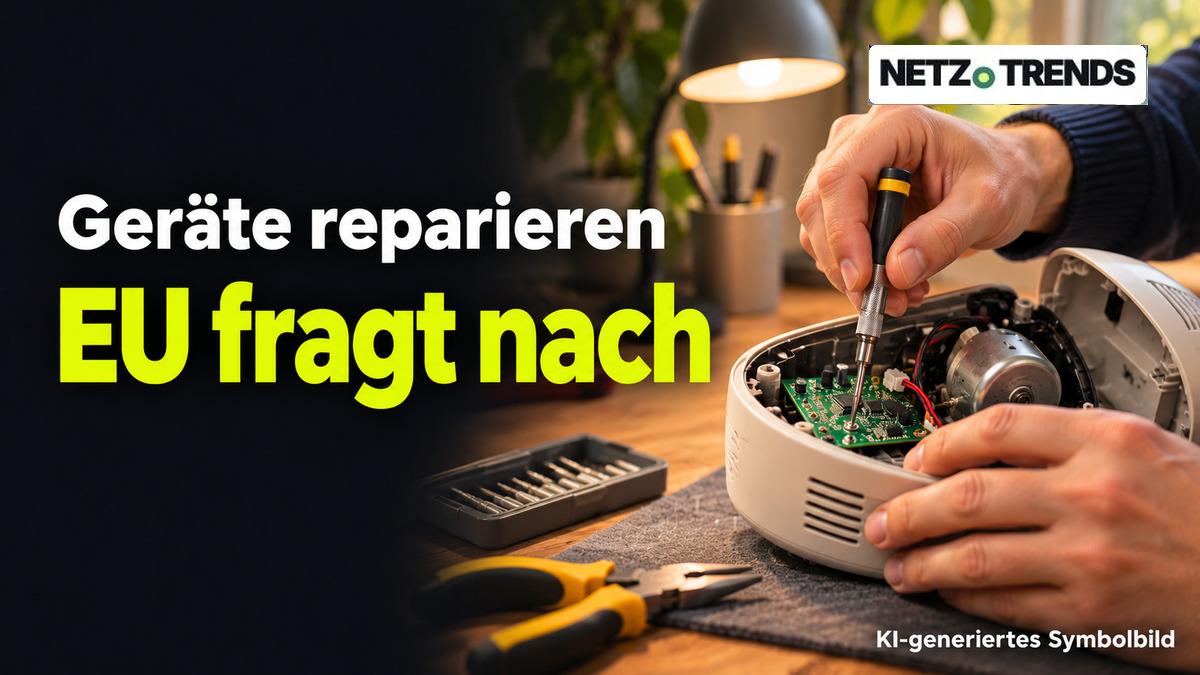
Until 9 February 2027, the European Commission is collecting evidence on hard-to-repair products – the UK already has its own, separate repair rules.
Key points
- The European Commission is asking for evidence on repair problems with consumer electronics, light means of transport and small household appliances sold in the EU.
- No new EU repair rules exist yet; the Commission plans an impact assessment by Q2 2027 and a possible measure in the second half of 2027.
- The UK is no longer bound by EU product law, but UK-based sellers placing goods on the EU market would still be covered by any future measure.
- The UK has had its own, separate right-to-repair rules since 2021 for products such as washing machines, dishwashers, fridges and televisions.
Anyone who had to replace a device early because spare parts were missing, repairs were too expensive or repair information was unavailable can now tell the European Commission about it. A consultation launched on 3 November 2026 is gathering evidence for possible EU rules on product repairability, with the deadline on 9 February 2027. For the UK, the direct legal effect is limited, but UK sellers trading into the EU and UK readers buying EU-made products both have a stake in it.
The European Commission wants to understand what stops people from getting products repaired before it decides whether and how to regulate. The UK left the EU single market regime after Brexit, so any resulting EU law would not automatically apply here – but it would still bind products placed on the EU market, including by UK-based online sellers.
What the Commission is checking
The European Commission opened a public consultation and a so-called “call for evidence” on 3 November 2026. This is an early stage of policymaking: the Commission asks citizens, companies and organisations for information before it finishes an impact assessment and decides on a concrete measure. The call explicitly states that it does not pre-empt the later decision or fix the final content.
As a possible legal basis, the Commission names a delegated act under the EU Ecodesign for Sustainable Products Regulation (EU) 2024/1781. That regulation sets the framework for product requirements; the consultation itself is not such a requirement. The Commission’s current timeline points to the impact assessment being finished in the second quarter of 2027, with a possible measure in the second half of 2027 – both can still change.
The Commission does not present the plan as a guaranteed saving for consumers. Its call for evidence says that better repairability could lower consumer costs over time, while manufacturers could face adjustment and compliance costs, and repair businesses and small firms may also be affected. These are expectations, not measured outcomes for any specific device.
What this means for the UK
Since Brexit, the UK is no longer bound by new EU product rules. A UK law firm’s analysis of the November 2026 consultation notes that UK businesses selling into or alongside the EU single market should still monitor the process: if a measure is adopted, it would apply to products placed on the EU market, so a UK brand selling into the EU would be in scope, and EU trading partners may demand firmer contractual compliance assurances from UK suppliers and distributors.
The UK already runs its own, separate repair regime. Since 2021, The Ecodesign for Energy-Related Products and Energy Information (Amendment) Regulations 2021 require manufacturers of products including washing machines, washer-dryers, dishwashers, refrigeration appliances and televisions to make certain spare parts available to professional repairers, enforced by the Office for Product Safety and Standards (OPSS). That UK regime is not changed by the new EU consultation and covers different product categories than the ones named in the EU call for evidence (consumer electronics, light means of transport, small household appliances).
Which products are in scope
Based on a preparatory study, the Commission names three broad, provisional product families, explicitly not final: consumer electronics (certain audio and video devices, wearables and accessories), light means of transport (certain e-bikes, self-balancing devices and some e-scooters), and small household appliances (kitchen appliances, personal-care devices and other small electrical goods). Devices already covered by product-specific EU rules, such as smartphones and tablets, are meant to avoid double regulation.
Smartphones and tablets placed on the EU market already carry an A-to-E repairability scale and must meet EU spare-parts and software-update rules since 20 June 2025. Those existing EU rules do not apply in the UK market as such, though many UK buyers import or compare EU-market devices, and UK-based brands selling into the EU must meet them for that market.
How to take part
The Commission’s consultation is run through the online portal “Ecodesign requirements on product repairability”, open until 9 February 2027, midnight Brussels time. The Commission accepts submissions in any EU official language; its public “Have Your Say” consultations are not restricted to EU nationality, though the Commission gives no guarantee about how non-EU input is weighted in the later assessment.
A concrete experience is more useful than a general complaint. Useful details include: the product type, model and age; which part failed and whether a replacement was available; what a repairer or manufacturer quoted for the repair; whether a software or firmware restriction blocked the repair; and how long the repair took, or whether no repair service could be found at all. This is editorial guidance, not a mandatory list from the Commission.
Frequently asked questions
Does this consultation create new repair obligations now?
No. The European Commission is gathering information and examining options. The call for evidence explicitly does not fix whether the initiative goes ahead or what its final content would be.
Does any of this apply directly in the UK?
Not automatically. The UK is not bound by new EU product law after Brexit. A future EU measure would apply to products placed on the EU market, so UK-based sellers trading into the EU would be affected; UK domestic repair rules for products like washing machines and TVs already exist separately since 2021.
Can UK residents submit evidence to the EU consultation?
The Commission’s “Have Your Say” portal does not state a nationality restriction for this consultation, but it gives no assurance about how submissions from outside the EU are weighted in the later impact assessment.
Your experience counts: which device was unusually hard – or surprisingly easy – to repair for you, and why?
Tell us in the comments.
Sources and status
- European Commission: public consultation on easier-to-repair products, 3 November 2026
- European Commission: “Ecodesign requirements on product repairability” consultation portal
- Regulation (EU) 2024/1781 on ecodesign requirements for sustainable products
- Directive (EU) 2024/1799 on common rules promoting the repair of goods
- European Commission: product rules for smartphones and tablets, applicable since 20 June 2025
- UK: The Ecodesign for Energy-Related Products and Energy Information (Amendment) Regulations 2021
- Lewis Silkin: analysis of the EU repairability consultation for UK businesses, 11 November 2026
Research and data as of: 15 November 2026.
Transparency note: AI-assisted tools were used in researching, structuring and writing this article. The sources used are listed in the article. Publication takes place only after manual editorial approval.
Share this article

Comment Tell us what you think →