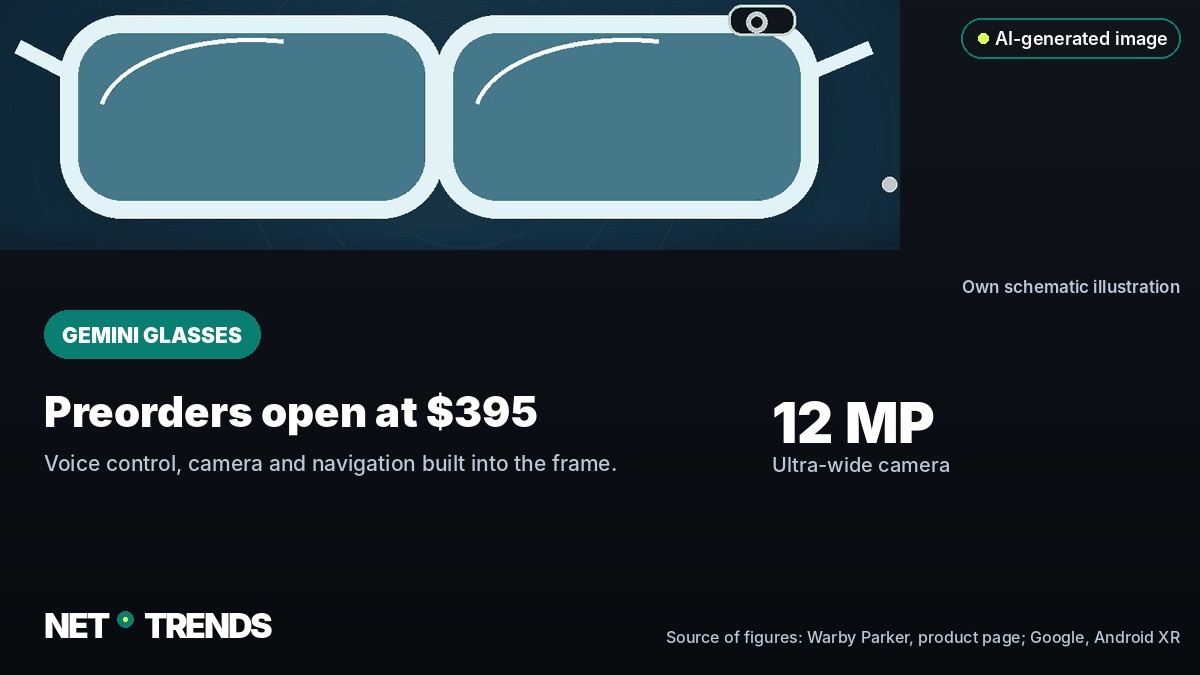
Warby Parker starts taking orders for its first Google Gemini-powered smart glasses, built with Samsung, starting at $395 for US buyers.
Key points
- Warby Parker is selling its new smart glasses in three frames starting at $395. The company calls this an entry price on its own product page; the currency and market are the United States.
- Google Gemini, a 12-megapixel camera, navigation and real-time translation are among the advertised features. The weight and battery figures come from the manufacturer, not from independent tests.
- The order page lists the US and Canada as the only markets. No international pricing or launch date appears in the sources checked for this article.
Glasses that take photos, translate speech and answer questions about what you’re looking at are now something you can actually order: Warby Parker began taking preorders for its first “Intelligent Eyewear” model on November 12. The starting price is $395.
The glasses are a joint project with Google and Samsung. According to the companies, Google supplies the Gemini features while Warby Parker provides the frames and optical options; Samsung is involved as a hardware partner. Warby Parker had already flagged the preorder launch in its quarterly report filed with the US Securities and Exchange Commission (SEC) on November 5.
Price and ordering
Warby Parker lists a starting price of $395 on its current product page, covering the Wren, Reid and Alden frames as prescription glasses, non-prescription glasses or sunglasses. The final price can change depending on lenses and prescription; the page does not list pricing outside the US.
Orders ship through Warby Parker. According to its FAQ, shipments begin in mid-December; prescription lenses can take up to 21 days to manufacture. The company also lists a 30-day return and exchange window from delivery. These terms apply to the US site and are not a substitute for checking the exact shipping and return conditions at checkout.
Camera, Gemini and battery life
The product page lists a 12-megapixel ultra-wide camera, 3K video recording, four microphones and open-ear speakers for calls, music and podcasts. Gemini can be called up by voice. Warby Parker advertises turn-by-turn directions, real-time translation, photo and video capture, and answers about whatever the wearer is currently looking at.
Warby Parker states the frames weigh about 41 grams. The company claims up to nine hours of use per charge, with the included case good for seven full recharges. These are manufacturer figures, not measurements taken by Net Trends; real-world battery life depends heavily on how much the camera, audio and voice features are actually used.
Google unveiled the glasses in May as part of its Android XR strategy. According to Google’s announcement, the audio glasses are meant to work with both Android and iOS phones. That does not mean every feature works identically on every phone or in every country: the product page notes that compatibility and availability vary, and some features require setup or a subscription.
Only US and Canada for now
The order page at https://www.warbyparker.com/intelligent-eyewear lists only the United States and Canada as shipping destinations. Warby Parker has physical and online stores across the US, so this is the company’s home market launch — but it is still an early product in a new device category. The company publishes feature claims and specs, not independent measurements of battery life, camera quality, translation accuracy or speech recognition. Buyers mainly looking for a regular prescription frame should not treat the extra tech as a proven everyday advantage.
Camera and privacy
The glasses can record photos and video and contain microphones. Warby Parker’s Intelligent Eyewear terms of use, updated on November 12, 2026, note that camera, microphone, AI and data-processing features may be provided by technology partners, whose own terms and privacy policies apply in addition. Warby Parker states that each technology partner is responsible for the features it controls and the related data processing.
The terms also remind users to be mindful of other people’s privacy when recording and to get any necessary consent. That is the company’s own contract language, not a full legal assessment of US privacy law. Anyone using a camera-equipped pair of glasses should avoid pointing it at people without their knowledge, follow workplace or venue rules, and read the privacy information for each connected service before setup. Under the company’s own terms, AI answers can be incomplete or wrong, so important information should be checked independently.
For now, the glasses are mainly of interest to US and Canadian buyers who want to try hands-free camera and voice control. Before ordering, it’s worth checking the actual features available at checkout, any extra costs, and the return conditions.
Frequently asked questions
How much do Warby Parker’s Gemini glasses cost?
Warby Parker lists a starting price of $395 on its product page. Lens choice and prescription can change the final price.
When do preorders ship?
According to Warby Parker’s FAQ, shipping starts in mid-December 2026; prescription lenses can take up to 21 days to make.
Can the glasses be ordered without a prescription?
Yes. Warby Parker lists prescription lenses, non-prescription lenses and sunglasses versions on its product page.
Sources and status
- Warby Parker: product page and FAQ for Intelligent Eyewear (accessed November 12, 2026)
- Warby Parker: terms of use, effective November 12, 2026
- Warby Parker: quarterly earnings release filed with the US SEC on November 5, 2026
- Google: announcement of Android XR intelligent eyewear, May 19, 2026
Transparency note: AI-assisted tools were used in researching, structuring and writing this article. The sources used are listed in the article. Publication takes place only after manual editorial approval.
Share this article