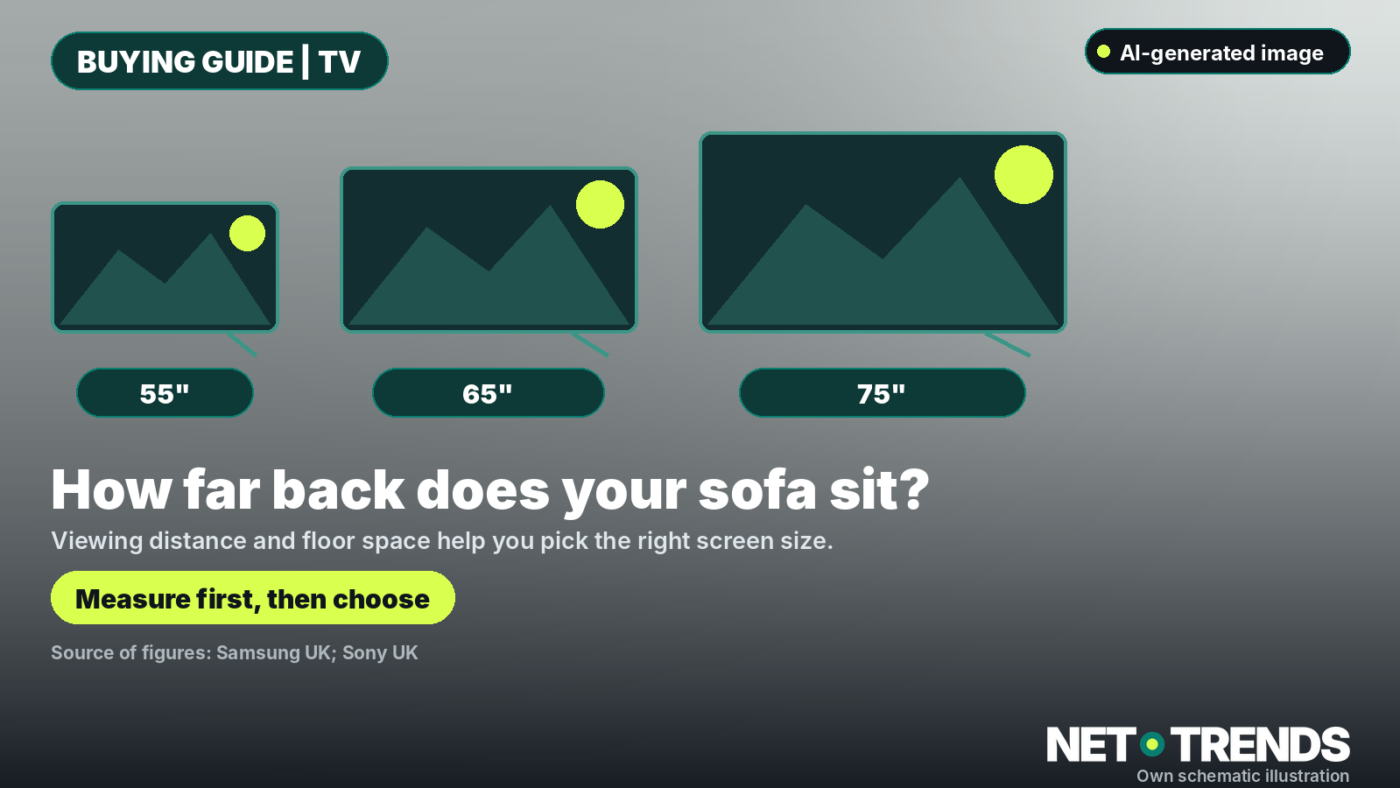
Viewing distance, resolution and floor space guide the choice
Key points
- 55, 65 and 75 inches describe the screen diagonal, not the width of the TV.
- On a 16:9 screen, the visible area is roughly 122, 144 and 166 centimetres wide.
- Manufacturers quote different viewing distances; the figures are guidance, not a universal standard.
Whether a 55, 65 or 75-inch TV suits your living room depends first on how far you sit from the screen and how you watch. There is no single ideal diagonal: resolution, the content itself, room layout and personal viewing habits all change the right distance. Before buying, two measurements help more than a one-size-fits-all rule: the distance from your seat to the screen, and the floor space you actually have.
What 55, 65 and 75 inches actually mean
The inch figure describes the screen’s diagonal measurement. One inch equals 2.54 centimetres. For a standard 16:9 format, the visible screen dimensions can be calculated from the diagonal. The table shows rounded figures for the picture area, not the outer dimensions of a specific TV.
| Diagonal | Diagonal (metric) | Picture area, approx. |
|---|---|---|
| 55 inches | 139.7 cm | 122 × 69 cm |
| 65 inches | 165.1 cm | 144 × 81 cm |
| 75 inches | 190.5 cm | 166 × 93 cm |
Going from 55 to 65 inches noticeably increases the visible area; stepping up to 75 inches needs even more wall or furniture width again. The bezel, chassis and stand add to that. Before buying a specific model, it’s worth checking the spec sheet for the dimensions “without stand” and “with stand”, as well as the distance between the feet — that can decide whether the set fits on an existing TV unit.
Manufacturer guidance on viewing distance
Resolution and source matter: according to manufacturer guidance, high-resolution 4K content can be viewed in more detail from a shorter distance than lower-resolution material. That doesn’t mean everyone should sit as close as possible. Sport, news, streaming and games also don’t always deliver the same picture quality.
Manufacturers’ figures aren’t consistent. Samsung UK’s TV buying guide gives a recommended viewing distance of around 1.7 metres for 55 inches, 2.0 metres for 65 inches and 2.3 metres for 75 inches. Sony, by contrast, treats 1.5 times the screen height as the minimum distance for 4K; Sony UK’s support article puts that at roughly 1.0, 1.2 and 1.4 metres for 55, 65 and 75 inches.
These figures shouldn’t be read as two competing buying rules: Samsung’s is a comfort or orientation distance, Sony’s a stated minimum. The gap between them shows there’s no single mandatory distance that applies across manufacturers. Treat the figure for your own model as a starting point, factor in the content you actually watch, and don’t rely on a single marketing formula alone.
How to check the space at home
Quick measurements before you buy
- Measure the distance from your usual seat to where the screen would sit.
- Check the specific model’s outer dimensions, including stand and foot spacing, on the spec sheet.
- Mark the screen area on the wall with masking tape, or cut a cardboard template to full size.
- From your seat, check that the whole screen stays comfortably in view.
- For wall mounting, consider the bracket, connections, cable routing and the wall’s load-bearing capacity.
A cardboard template makes the size difference visible in your own room, but it doesn’t replace a proper technical check of the mounting. If there’s any doubt about the wall or bracket, it’s worth confirming before buying that it can carry the weight and fixings of the chosen model. Reflections from windows and lamps, and the viewing angle from more than one seat, can also change the decision.
If you’re torn between two sizes, compare the measurements on the wall with the manufacturer’s figures for the specific set. A bigger screen isn’t automatically the better choice; what matters is whether the picture size, seating position and available floor space actually work together in your room.
Frequently asked questions
How wide is a 65-inch TV?
The visible 16:9 picture area works out at roughly 144 centimetres wide and 81 centimetres tall. The chassis itself can be larger. For floor space, the specific model’s spec sheet is what counts.
Is a 75-inch 4K TV always a good idea at short range?
Not automatically. Manufacturers give different orientation and minimum distances. Check whether you can comfortably take in the whole screen, and whether your content is mostly available in the resolution you’re relying on.
Is there a binding minimum distance for watching TV?
The sources cited give model- and resolution-dependent orientation or minimum figures, but no single shared benchmark for all TVs. What matters for the purchase is the specific model and your own viewing comfort.
Which size are you considering — 55, 65 or 75 inches — and how far back does your sofa sit? Feel free to share your experience in the comments, without any personal details.
Sources and status
- Samsung UK: recommended viewing distance by screen size, accessed 9 November 2026.
- Sony UK: minimum viewing distance by resolution, accessed 9 November 2026.
Research as of: 9 November 2026. The screen dimensions in the table are our own geometric calculations for a 16:9 picture based on the stated diagonal; chassis dimensions vary by model. No TVs were tested.
Transparency note: AI-assisted tools were used in researching, structuring and writing this article. The sources used are listed in the article. Publication takes place only after manual editorial approval. The header illustration was also produced with AI assistance and is clearly labelled. Translation of the German original on Net Trends.
Share this article